

I don't have much to say about these, except for the rattlesnake. But I shall caption them.
 A nighthawk.
 A ponderosa pine. Ponderosa pines have a silhouette that is itself a classic icon of the west. They can be recognized by their rounded tops.
 A damselfly. Damselflies are similar to dragonflies, but are slimmer, and fold their wings onto their backs when they rest.
 The Yampa River after the big storm we had while rafting. The storm turned the waters reddish-brown beyond a certain point at which the reddish Phosphoria Formation, above the pale Weber Sandstone, was washing down the cliffs into the river. Here the water behind the sandbar is its original yellow color, the water beyond it more reddish, which color it remained for several hours.
 Many ranches have posts over the entrance with various horses, cowboys, bulls, etc. upon them. This one near the park was a little more creative.
 DP rides a captive brontosaurus.
 A news item in Vernal.
 The mineralogy book that my field partner found in the middle of nowhere, in a crevice in some rocks far from any trail. It had a name and a number. However, the number didn't have the right amount of digits to be a phone number. And I can't imagine why anyone would put their SSN in a mineralogy book.
 Old juniper wood.
 A flower. Obviously.
 This cabin is on one of the county roads that allow access to the east end of the park. The sign reads: "$1,000 REWARD for information leading to the CONVICTION of anyone STEALING, MOLESTING or POACHING [illegible] or PROPERTY [illegible]."
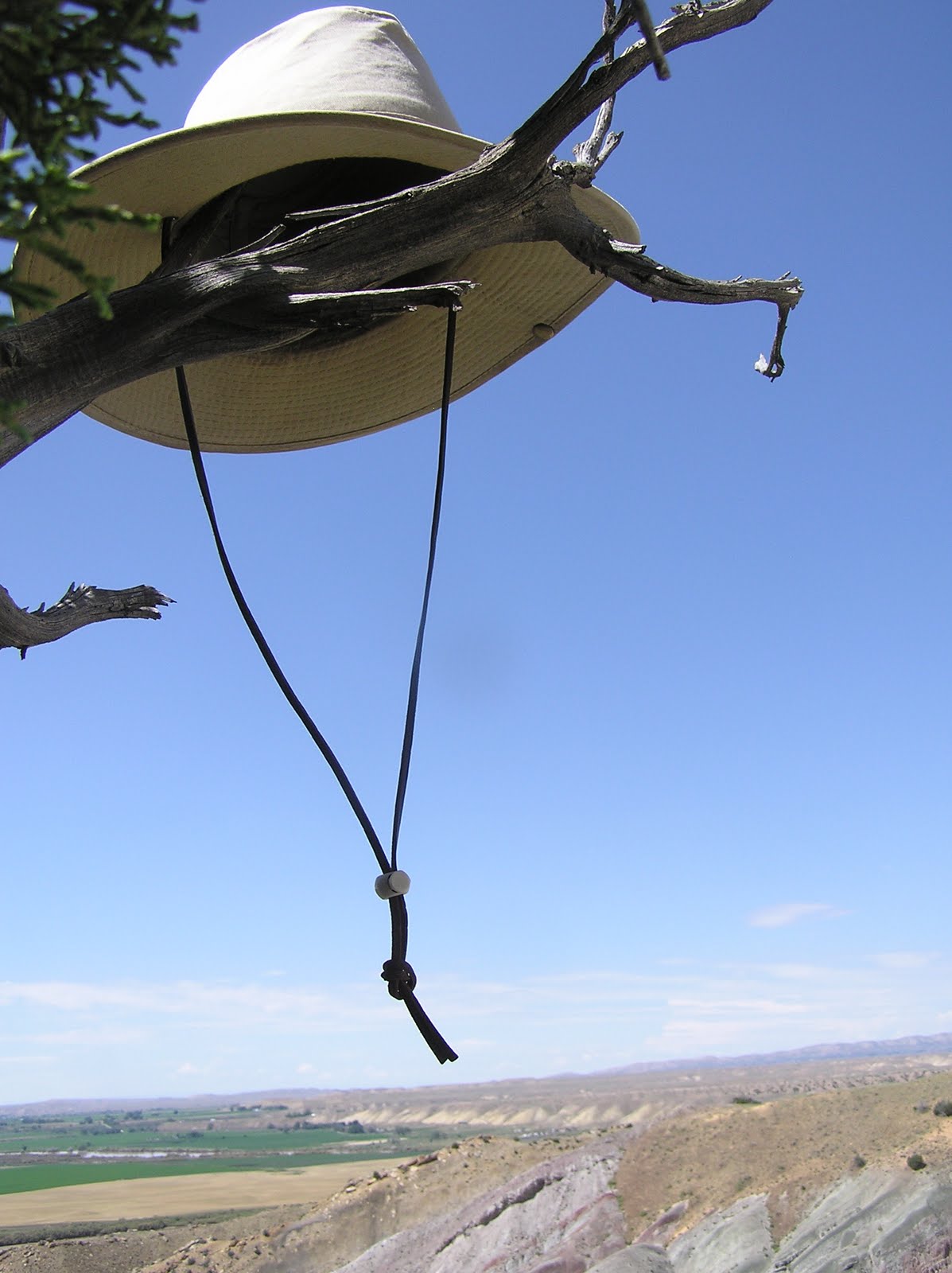 My hat, and some scenery.
 A worked point (i.e., Indian artifact) I found in the field.
 My field partner at work.
 A storm beyond the housing area.
 Students and volunteers on the University of Utah team doing research in the park pause in trying to remember the Seven Dwarves to catch a Sharpie, here suspended in mid-flight.
 DP in a slotty portion of what was generally a non-slot canyon.
 Investigating the nicest track site we found. The prominent trackway stretching from foreground to background was made by a small mammal-like reptile walking up a dune 200 million years ago.
 Not The Rattlesnake, but a rattlesnake we walked right past before realizing it was there, a foot from our feet.
 Fantasy Canyon, south of the park.
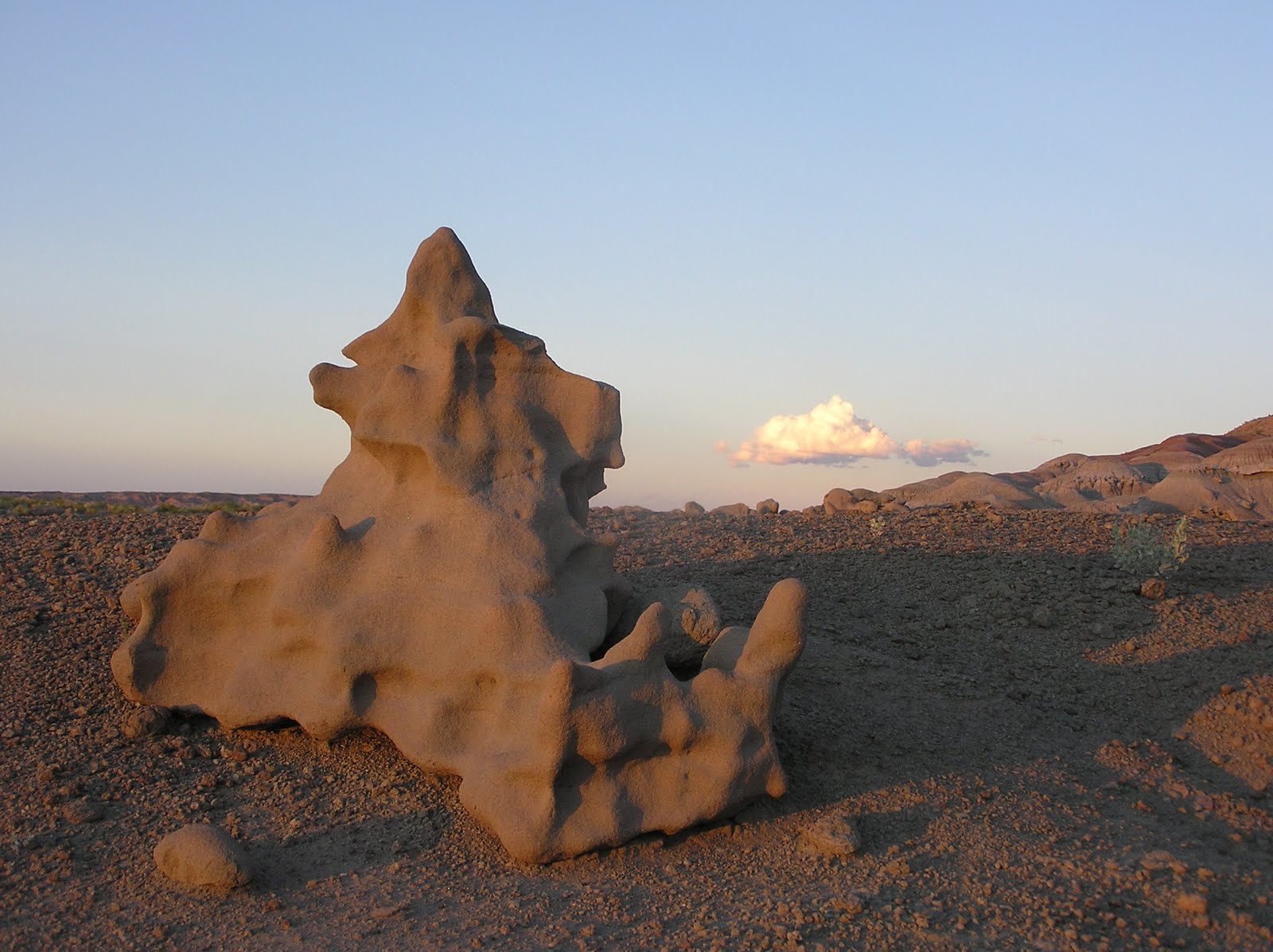 Also Fantasy Canyon.
 Sunset from Fantasy Canyon.
 Flaming Gorge, north of the park.
 Flaming Gorge Dam.
 A sign below Flaming Gorge Dam that practically invites you to read it the wrong way.
 There were many signs here.
 Cross-bedding in sandstone.
 The moon rises over Blue Mountain. As seen from the housing area.
 Some trees on the Ruple Point Trail.
 A picture of me at Moonstone Arch outside the park, taken by a co-worker.
 And me hiking back from a day of field work.
 And me in front of the wall of bones at the visitor's center that will reopen this October.
 I scale the stegosaurus model outside my office. For no good reason.
 Also for no good reason.
 Oh, yes, back to the beginning of the summer, when I was trying to get the frisbee off the roof with a grappling hook made of two pairs of salad tongs.
 We take the pledge to become Junior Paleontologists.
 Our album cover. Actually, this is the team I worked with for part of the summer.
 Second album cover.
 Third album cover. Obviously, this is after we fired our drummer.
 My goofy field partner Keegan at the wall of bone.
 We pose in some shots for my supervisor's blog.
 I look up at the reverse image of some footprints.
 Our evil supervisor watches over us as we slave to dust off a fossil trackway.
 Me and femur.
Now, The Rattlesnake. My field partner and I were hiking through a wash on our way back from a hard day of field work when he told me I just stepped on something. I looked around. This is what I had just stepped on.
 It was a baby midget faded rattlesnake eating a lizard. The rattlesnake did not do anything; it just sat there.
We watched it for a bit.
"It can't bite us," I said. "It has a giant lizard stuffed in its mouth. We can touch it. This could be the only time we're ever able to touch a rattlesnake."
I touched it. It sat there. After several minutes of gathering up his courage, my field partner touched it, wincingly.
Immediately after he withdrew his hand, the rattlesnake spat the lizard out with lightning speed and slithered away, keeping its head turned to watch us, shaking its not-quite-a-rattle-yet tail, to coil in some grass a couple feet away.
 Okay, so it totally could have bitten us. One of the stupider things I've ever done. Still, we survived!


