Painted Desert

Painted Desert

Sunday, August 28, 2011

Dedicated to the god of electronics

The backpacking trip. I'd been planning this trip in the park's wilderness all summer, which for me usually involves a lot of staring at maps, trying to imagine where would be the best place to go, how long it would take, how much water I'd need to bring. I had been thinking about this thing for three months. And I was pretty sure I was going to do it--pretty sure because my potential backpacking partner and I had only discussed the trip once, in a half-assed way, more than three months ago, and I generally consider it to be asking a lot of any human being to have them save a date and then drive six hours to meet you when the original conversation lasted barely a minute. But Kris was there.

We were going to be hiking into a mostly trailless area that included two tributary canyons of the Yampa River and the Yampa itself. I had been assured that the tributary canyons had been hiked by many others and that they contained no drop-offs too steep to navigate. I thought we would probably hike six miles the first afternoon.

But quite early we came to a series of large cliffs below us, twenty to sixty feet each, with no apparent way down into the rest of the canyon. No safe way, I should say. We might, from a distance, see a possible way down one drop, but have no clue how to get down from the ledge the first path might lead us to. We scouted for an hour in the August sun, climbing all over the rocks on the cliff edges, before finding what appeared to be a safe way down that would take us back and forth across the cliffs in a series of smaller drops.

Above, one of the sections of cliff to be navigated. (Once you get to the lower cliff, how do you get off it?)

We did not mean to take any risks. The only difficult part of this route was a drop of about four feet that we couldn't make with our big backpacks on, so we took them off and dropped them the four feet, then hopped down after them.

When I dropped my pack it hit the rock hard, and a small black thing flew off it and bounced off the edge of the next drop, which was about 10 feet away from us. As it was flying through the air I realized it was my camera. I waited for what seemed too long to hear it land and then Kris and I both heard a noise that was way too loud. It sounded like the camera had connected with solid rock at about 100 miles per hour.

At this time I must mention that my phone had jumped out of my pocket in the wilderness a few days before, and after an hour of searching had departed empty-handed, despondent and connectionless in the Middle of Nowhere, Utah, and unhappy to discover that T-Mobile will not ship to PO boxes. Now my camera had decided it would rather throw itself off a cliff than live with me any longer.

It took us a while to get down to the bottom of that cliff, and then another while to find the camera. It was beneath a big rock that I assumed it had hit. I opened the case and saw that the camera was not dented. I turned it on and it turned on. I took a picture with it.

Kris, on the hunt.

MY CAMERA survived a 60 foot fall, landed on a rock, and still took pictures. I have since discovered that it now can't be changed from the auto setting, but still. It reminds me of the pen I lost in the Wyoming wilderness one summer and then found more than a year later when I was fossil-hunting in the area. Did it still write? YES.

Here is me below the cliff, which was 50 or 60 feet high.

We wandered down the canyon for another hour or so before stopping for the night. It was very quiet, no hint of civilization anywhere.

The sun setting on the canyon walls

The next day, while hiking toward the Yampa, Kris and I discussed the merits of hiking in trailless areas. I generally prefer hiking where there's no trail... at least, I do in the West, where there's less vegetation... because it keeps your mind so busy trying to figure out how to get where you want to go. There is much less boredom, and also less pain, as I don't notice my feet hurting. But it certainly wasn't easy. We whacked many bushes, and had to squeeze through crevices in the rock, or make jumps difficult to make with 30 pounds of pack on. Or both of the latter, at the same time. At one point I was held with my feet dangling in the air by my pack which was still wedged between the rocks above and behind me.

Kris squeezes through a crevice

But this was real wilderness. We saw many elk antlers, including these, still attached to the skull:

The canyon walls towered above us.

Finally we made it to the Yampa River. We needed to proceed downstream to the next tributary canyon, where we would climb out, but the river (which, you may recall, was much swollen this year with snowmelt and Spring rains) had not dropped as much as it usually does by August and was bordered by steep cliffs instead of rocky beaches. We needed to find a way up onto the tops of the cliffs in order to get safely downstream. Another hour of scouting in the rain provided a path.

Up on the cliff, looking down at the river

Kris, unable to resist, pushes against the rock on the edge of the cliff. It won't budge.

Here is a shot of the bend in the Yampa where we camped that night. I had expected to see rafters on the river, but we never saw a soul, on the water or off it. I assume that no trips had been planned because often, by this time of year, the river is too low to run.

We took a little hike up into a massive alcove in the cliffs over the river. I turned back to take a shot of some of the terrain we'd just crossed:
For a sense of scale, look for Kris in this shot, reclining above the sheer drop. Click for detail:


By the time we set up camp, the sun decided to come out, and it was everything you might ask for, warm and breezy and quiet and lovely, and with good food too:

Fresh sauteed squash and zucchini with basil and parmesan. On the beach, no less. Again, not a soul in sight. That night the full moon came up, first turning the high rock faces across the river white for an hour before it finally appeared above the cliffs over our heads.

The next morning we took a dip and lounged around in our hammocks before making the short hike up and out to the car.

Once on top, we paused for some photos of where we'd been...

And, of course, of ourselves--

and Kris drove the six hours back to Denver--she had to get back, you know, she had to get up the next morning and drive another three hours to a whitewater rafting trip--and I spent one more night at the park, a stormy night in which a pint of dust blew into my tent, and the next day went hunting for plant fossils with some of the park staff.

We found many things. Here are a couple of the better items I found. A leaf:

Fossil insect. Click for detail.


On the way back, I noticed that something very special was about to happen to my car, and took a picture!

Unfortunately, I was a split second too late. So now I have a picture of my odometer with 111,112 miles on it.

I am getting settled back in Denver now, but there will be more posts to come!

Wednesday, August 03, 2011

Weekend adventures


A couple weekends ago, I went to Park City, Utah, to visit a friend from URI who was doing her master's thesis research in the area. There were balloons.
Her field area was quite different from mine. It was about 5,000 feet higher, for one; also a bit cooler.
She was there to study how the rocks making up the mountains had affected the way the glaciers had sculpted out the valleys, when there were glaciers. Here, she and a fellow student use a tool for testing concrete hardness to measure the hardness of the rocks. It had a piston that slammed against the rock.

I wanted to use it to test the hardness of my thighs, after hiking all summer, but they were afraid I was going to break my leg.

I also visited Park City itself, which is an extremely wealthy-looking ski resort town.
I was surrounded by all the things I couldn't get in Vernal, like gourmet food, and in my deprivation and weakness spent a little more than I had intended to.

The following week we found some 200 million year old scorpion tracks, the first we have seen. They look a lot like the scorpion tracks on my (modern-day) track identification card... though they may be difficult to see in the picture, as the light was not very good for photographing them.


Me in the field!
That ichthyosaur I found earlier in the summer... a team doing research in the park who had a permit to collect on BLM returned to it, and found many more bones, dozens of pieces. Here some of them are applying a consolidant to bone fragments that have been excavated, while others search for more bones that have weathered out and rolled down the hill:


Then, this past weekend, a visit from a dear friend!

DP and I had many fine hikes and discovered many interesting things in the wilds of Utah, such as this:
At the last park I worked at, one of the rules for field work was "No matter how far you are from civilization, you will always find some discarded can or bottle." Well, here were dozens of them, in the middle of nowhere. Along with some boot heels. The rule is true, though. If you are ever hiking in the backcountry you can test it for yourself.

A mountain lion print. Somewhat disconcertingly, these prints were only seen on our path during the hike out; they hadn't been there on the hike in. No sight of the lion though.

I will be wrapping up here next week, and I'm not sure I'll have time for another entry then, but there are still many more photos and stories!

Friday, July 22, 2011

Ichnology


Ichnology, from the root word ichnus, meaning "trace," is the study of trace fossils. Traces are what's left behind by living organisms. They could be burrows, footprints, trails, borings in wood (or rock or shell or bone), an impression left where an animal rested, or even tooth marks. Above, you can see a footprint left by a three-toed creature from the Triassic. In many ways, ichnology is more exciting than regular paleontology, as you are not just looking at the bones of a dead thing, but at where the living animal walked and what it did.
A trackway showing several three-toed prints.

Since it is impossible to know for sure what kind of animal made each ancient trace, we don't speak of Ankylosaurus tracks or shrimp burrows, but instead give each kind of trace its own scientific name and classification; its own ichnotaxon. One variety of burrow is named Ophiomorpha (meaning "snake-shaped"), and it is similar to the burrows made by modern shrimp; one type of track I have seen this summer is called Brachychirotherium ("short-handed beast"), and it may have been made by aetosaurs.

Ichnology is informed by neoichnology, the study of modern traces. If you happen to live near sand or mud, then you are surrounded by traces. Here are some I have seen in the park this summer. You may distinguish the bird, mammal, reptile, and insect traces. Click pictures for detail.
Unlike body fossils, which are best preserved by being buried quickly, tracks seem best preserved if buried slowly. A dinosaur may walk across a damp sandbar in a river; if the sand is fine-grained, or has some mud in it, the tracks may show up nicely. They may dry out a little and start to harden, before the rains come, the river rises and slowly more sand or mud is deposited on top of the tracks. (To learn more about dinosaur tracks, check out this very interesting site.)

It is not always easy to find, or recognize, trace fossils. Often we must look on the underside of ledges, for the "negative" of a footprint, made from the sand that washed into the print after it was made:


And some traces are impossible to see unless you know what you're looking for.
These are Brasilichnium ("trace from Brasil") tracks, made by a mammal-like reptile walking up a dune face. We know they are tracks because of the "push-up," or crescent of sand behind them that modern trackmakers also leave. (Click here to see some better Brasilichnium tracks.)

The Navajo Formation, where I am working, was formed in an erg, or sand sea, one superficially like the modern Sahara. There are not a lot of creatures in the Sahara--at least, not, say, as compared to the Amazon rainforest, or even your backyard. So there are not a lot of traces. Most of what we've found are arthropod burrows. They are distinguished by how they cut across the bedding of the sand in which they're found:

The first two were, perhaps, made by beetle or fly larvae feeding in the sands. The third may have been a spider or scorpion burrow.

Some burrows can be seen right on the top of a bed, and may contain "menisci" made by a creature pushing sand behind it as it tunneled:
And some burrows may be seen in relief as the sand weathers:
But so far, the only tracks I and my partner have found have been the tracks of arthropods (perhaps spiders)--no dinosaurs, no early mammals. They are shown here:

In the second, only the orangish stripe was exposed above the sand, and I saw some dots on it. scraping the sand away revealed a trackway.

So what good is ichnology? Dinosaur or mammal tracks can tell us about stride length, and possibly whether dinosaurs traveled in herds, but probably the most useful aspect of ichnology is the study of invertebrate traces. Since scorpions or shrimp or worms can't travel great distances, we know that they belonged in whatever environment we find their traces in, and thus they allow us to infer a great deal about the environments in which different rocks were deposited. This adds to our knowledge of previous environments and climates on our continents, and also helps the oil industry find oil.


Here, we help a team from the university carry out a slab with traces on it made by a swimming reptile.

Nothing I've found this summer has been at all spectacular, sadly, and the nicest things weren't even in the formation I'm supposed to be working in, but from the Chinle Formation, which was formed in a river system and had a lot more things living in it.
Very small tracks, presumably from an arthropod! That is my compass in the corner.
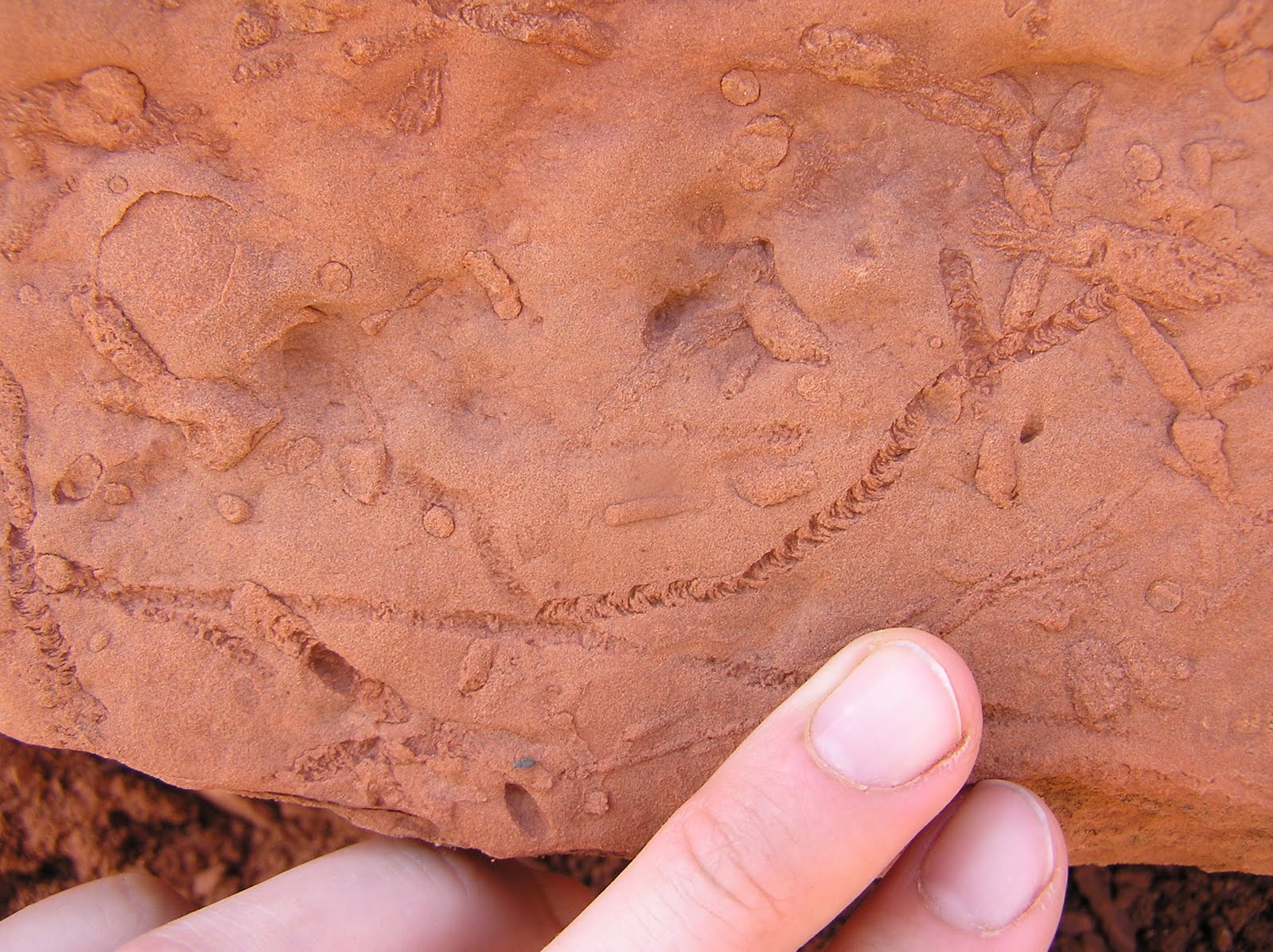
Very nicely preserved burrows.

Lizard footprints. There are three of them in the picture, though they are a bit difficult to see.

You my readers, who are mostly Connecticut and Denver, have wonderful places to view dinosaur tracks close to home. Dinosaur State Park in Connecticut and Dinosaur Ridge in Morrison are both world-class sites and enjoyable day trips.

Till next time!