This is, more or less, what I bring with me. (A few things didn't make it into the pictures because I forgot about them until later, but I'll still be mentioning them below.) I'll list each item briefly for the mildly curious. After that, I will go over every item in more detail so you can read about why I use that item or what I like/don't like about it. You can search for the extra detail by using the item's name or number.
This gear set is optimized for use in the Colorado Rockies, by a woman who gets cold easily. All these items, with water and a weekend's food added - save the items I wear - weigh about 22 pounds together.
If you look up these items you will find that some of them are extremely expensive. Top-quality items are not necessary to have fun, but I backpack enough that high-end gear is worth it to me. A higher price tag buys you lighter weight, better waterproofing, and (often) greater durability, meaning you will be less tired and wet and may have fewer field failures. But attitude, not gear, is the main determiner of how much fun you will have backpacking.
Almost nothing I use was purchased at retail price. Outdoor gear sales are frequent, and at used item sales such as the REI garage sales you can get barely-used items at half off or more.
PACK

01. Pack - Gossamer Gear Mariposa 60 liter pack

02. Back pad: tucked in the back of the pack is a Gossamer Gear Thinlight pad.

Fully-loaded pack hanging on tree
IN PACK

Top left:
03. Food bag: Ursack Major
04. Odor control: Loksak Opsack
05. Hydration: Platypus Big Zip LP 3 Liter hydration bladder, stock bite valve replaced with Camelbak bite valve
06. Water treatment: Sawyer Squeeze hollow fiber filter connected to bladder hose with Sawyer In-Line Adapter
Middle left:
07. Pack liner: trash compactor bag
08. Base layer: orange synthetic shirt from thrift store
09. Insulation: fleece pants from Dick's Sporting Goods
10. Pad: Therm-a-Rest NeoAir XLite
Bottom left:
11. Mid layer: blue long-sleeved synthetic shirt from thrift store. I will bring this OR #58 dependent on temps. This one is for cooler weather.
12. Extra socks: Darn Tough merino/synthetic blend hiking socks
13. Reading material: book. I only bring a book sometimes.
Right:
14. Sleeping bag: Western Mountaineering Apache MF 15 degree down bag
15. Jacket: Arc'Teryx Thorium AR down hoody
Not shown, because I forgot it:
16. Fuel: I use either the 110g or 250g canisters, any brand
OUTSIDE OF PACK

The Mariposa has a whopping 7 external pockets, allowing easy access to a lot of items. One of these is a tent pocket along the side, which lets you to store your wet tent without getting anything else wet.
Top row:
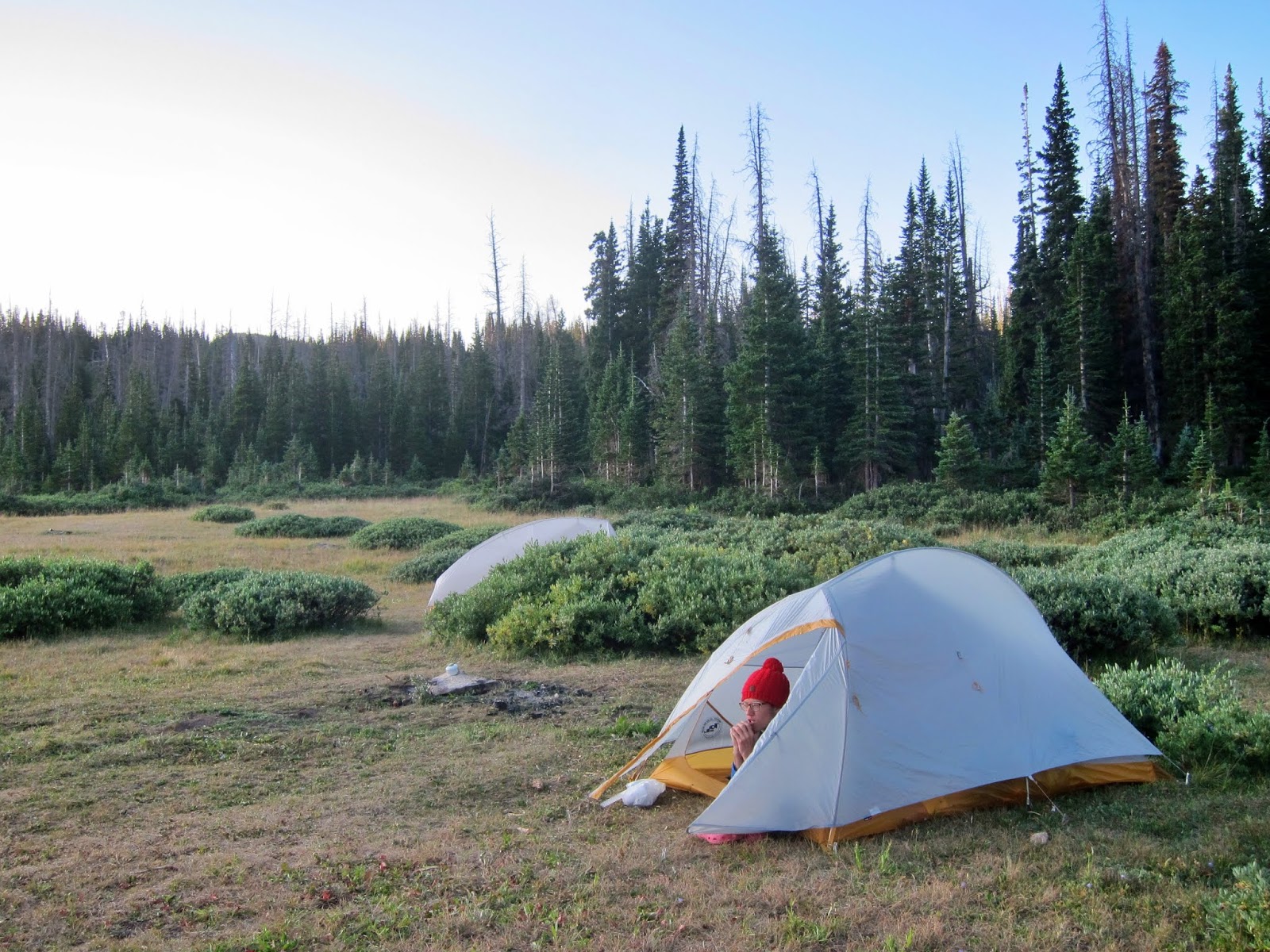
17a. Tent (body, fly, and poles): Big Agnes Fly Creek HV UL 1
Second row:
18. Tent footprint: DIY polycryo sheet made from Duck patio door shrink film kit
17b. Tent (stakes): Big Agnes Fly Creek HV UL 1
19. Filter accessory: Sawyer Squeeze syringe for backflushing Sawyer Squeeze filter
20. Filter accessory: quart ziploc with one corner cut off for drawing water from shallow sources
21. Sundries bag: see below for contents
22. First aid kit: see below for contents
23. Extra bag: supermarket bag
24. Bandana: cotton bandana
25. Carabiner: Gossamer Gear Mini Biner
26. Camp/water crossing shoes: Dawgs something... not sure they make this model in adult sizes anymore
Third row:
27. Pot: OliCamp Space Saver Mug
28. Stove: Snow Peak GigaPower canister stove
29. Ball: racquetball for rolling out muscles
30. Headlamp: Princeton Tec Fred
31. Head net: possibly Coghlan's?
32. Gloves: possibly Fox River? fingerless wool gloves
33. Warm hat: Repreve synthetic cap (no longer made)
34. Bug spray: Sawyer 20% picaridin insect repellant, 3oz. size, in quart ziploc in case of leakage
35. Hammock: netting hammock from Walmart (no longer sold)
36. Spoon: Toaks titanium long handled spoon
37. Trowel: sand stake from REI
Bottom row:
38. Quart ziploc: holds hygiene items. Inside, items 38-40...
39. Anti-chafing: BodyGlide pocket size
40. Cleaning: Wet Ones sensitive skin fragrance & alcohol free wipes placed in ziploc
41. Floss: one strand of floss
42. Toothbrush: no, I do not cut the handle off (I typically do not bring toothpaste on weekend trips, either, but still brush).
43. Sunglasses: sunglass film roll that you get when they dilate you at the eye doctor
44. Trash bag: sandwich size ziploc for putting snack wrappers and litter into while I hike
45. Sunscreen: travel size tube
46. Lip balm: with sunscreen
47. Sanitizer: travel size sanitizer bottle
48. Rain pants: Marmot Precip pants
49. Rain jacket: Patagonia M10 (no longer made)
Not shown, because I forgot them for photo:
50. Map of area: I prefer National Geographic Trails Illustrated maps
51. Phone: Sony Xperia XZ1 Compact phone
52. Camera: Sony RX100 miii
53. Battery: extra camera battery
54. Toilet paper: just enough for the trip, in a ziploc
WORN

Top row:
55. Sun hat: Prana cap
56. Watch: Armitron digital watch with alarm from Walmart
57. Socks: Darn Tough merino/synthetic blend socks
58. Boots: Altra Lone Peak 4 Mid RSM (Men's)
Bottom Row:
59. Shorts: track shorts from thrift store
60. Mid layer: REI Sahara shirt. I wear this OR #11 dependent on temps. This one is for warmer weather.
Not shown, because why would I show you my underwear:
61. Underwear: cotton briefs
62. Bra: regular bra
FIRST AID KIT

Top row:
63. Antibacterial: small antibacterial packets
64. Blister patches: ENGO blister patches
65. Bandaids: large bandaids
66. Tape: Leukotape strips
Second row:
67. Bandage: self-sticking stretchy bandage roll, with...
68. Gloves: nitrile gloves tucked inside
69. Sewing kit: that's what it is.
70. Bandaids: medium bandaids
71. Blister pads: 2nd Skin blister pads
Third row:
72. Foam: callus cushions
73. Antiseptic: iodine prep pads
74. Gaze: gauze pads
SUNDRIES BAG

Top row:
75. Paper: scrap paper for writing
76. Pen: it's a pen!
77. Reading material: article ripped out of a magazine (I often bring this instead of a book)
78. Bags: more ziplocs, because bags are oh so handy
79. Bags: bread bags. Can go over dry socks and back into boots to keep dry socks dry, or over hands to keep gloves dry when using trekking poles
80. Patches: patches for sleeping pad repair
Second row:
81. Lighter: Bic lighter
82. Knife: Victorinox Swiss Army Nail Clip knife with nail clipper, scissors, tweezers, toothpick, nail file/cleaner, and small blade
83. Tape: medical tape
84. Medicine: small container for earplugs which carries not earplugs but my medication and NSAIDs
85. Candle: birthday candle for help getting a fire started in emergency
86. Hair tie: it's a hair tie. Useful for hair, or attaching things to things
87. Filter: coffee filters for use as pre-filter if water has high sediment content
88. Paper clip: for who knows what
89. Safety pins: you never know
90. Game: 1.5" playing cards
91. Earplugs: Mack's slim fit soft foam earplugs -- in clear tube, along with...
92. Back-up light: small LED light -- also in clear tube
Bottom row:
93. Medicine: antacid and anti-diarrheal medications, with dosing instructions
94. Pads: two panty liners, held with rubber band around..
95. Mirror: S.O.L. rescue flash mirror, small
96. Tape: Gear Aid Tenacious Tape gear repair tape
97. Compass: Brunton TruArc 3
98. Matches: UCO Gear compact safety matches
Not shown, because I forgot to put them in:
99. Keys: house and car keys only
100. Driver's license and credit card
Optional item (not shown):
101. Umbrella: Six Moon Designs Silver Shadow
DETAIL
Now, here's a little more detail about these items. Why do I carry them, or why do I use that kind/brand/etc.?
PACK
01. Pack - Gossamer Gear Mariposa 60 liter pack
I like this pack. I settled on it after trying a few different lightweight packs. It's 2 pounds and carries up to about 25 pounds comfortably, and 30+ without terrible discomfort. I like the large amount of space in the exterior pockets, letting me reach a lot of things without having to dig into my pack. I don't like doing off-trail hiking in forest or brush, so I don't have to worry about items/pockets getting snagged much. This is a good pack for my needs.
02. Back pad: tucked in the back of the pack is a Gossamer Gear Thinlight pad.
The Mariposa comes with an egg-crate-type pad in the pack, which can be removed and used as a sit pad. I replaced this pad with their Thinlight pad, which when unfolded can be stacked with my air mattress pad for extra warmth. I can also spread it out on the ground for doing my physical therapy exercises.
IN PACK
03. Food bag: Ursack Major
The kevlar-like fabric of this bag cannot be torn by bears, so in theory it keeps scavenging bears from getting a food reward from raiding human campsites. Since bears apparently can't untie knots, you simply tie it to a tree, which is about a thousand times easier than hanging a traditional bear bag. Based on what I've read, I'm somewhat skeptical that the Ursack is anywhere near as good as a bear canister in terms of either protecting your food or protecting bears (that is, bears can still get a taste from punctured food packaging, and may be encouraged to seek out more human campsites to raid, resulting in their eventual extermination). However, it's much lighter than a bear canister and considering that problem bears have been extremely rare in Colorado (outside of Rocky Mountain NP), I am going with this for now.
I bring about a pound and a half of food per day.
04. Odor control: Loksak Opsack
These heavy-duty zip plastic bags are meant to go inside the Ursack and stop food odors, lessening the chance of a bear discovering your Ursack. Some on the internet have pointed out that a bear's sense of smell is that they can detect such that such and such tiny number of scent molecules in the air from such and such a distance, but I tend to think that less scent is better overall and so I use them. The trash goes in here too, and at night any other scented items do as well.
05. Hydration: Platypus Big Zip LP 3 Liter hydration bladder, stock bite valve replaced with Camelbak bite valve
I love this bladder. Easy to fill, easy to close, doesn't have the horrible taste that Camelbak bladders have. I didn't like the Platypus bite valve so I put a Camelbak flow switch and bite valve on it. Usually I do not put the bladder in the bladder sleeve in the pack, because it's a pain to get it in there when the pack is packed. I just sit it on top of everything next to my food.
One of the complaints against water bladders (prompting some to use bottles instead) is that they tend to leak, either through failed parts or user error. Since I pack my sleeping bag, clothes and book in the trash compactor bag, they're safe from water or fuel spills and I don't have to worry about leaks.
06. Water treatment: Sawyer Squeeze hollow fiber filter connected to bladder hose with Sawyer In-Line Adapter
I love the Sawyer Squeeze too, specifically having it inline on the hose. I fill the bladder with dirty water and suck, and it pulls through the filter. Some people don't like this because it reduces the flow rate from the hose, but it doesn't bother me. I love getting clean water without any pumping, squeezing or waiting. When I'm with a partner I use it as a gravity filter to make clean water for them too, hanging the bladder and letting water flow through the filter.
07. Pack liner: trash compactor bag
I don't use my sleeping bag stuff sack, both to save weight and because the stuffed sack is rounded, which isn't a good use of space. Instead, I put the trash compactor bag in the pack and stuff the sleeping bag right into the bottom of it. Then I put my clothes, pad, and book in and roll the top of the bag over. These things are now more or less waterproofed -- at least, better than they would be by a stuff sack or a pack rain cover.
Plastic bags are always a good thing to have along, and an especially large one is especially good. It could be used to carry a large amount of water to douse a fire, or shaped into a poncho, or used as a bellows to inflate your sleeping pad if your lungs are struggling in the alpine air, or put over the end of your sleeping bag to protect it from condensation, or many other things.
08. Base layer: orange synthetic shirt from thrift store
Love this shirt. Synthetic is more comfortable than cotton when wet and it dries much faster. Some brands/blends are better than others at combating odor.
09. Insulation: fleece pants from Dick's Sporting Goods
Many people do not need a layer like this, or use a thinner one such as long underwear. But I get cold easily once I stop moving. These pants can be pulled over my shorts. I wear them around camp in the mornings and evenings (under my rain pants) and to bed.
10. Pad: Therm-a-Rest NeoAir XLite
This is the best pad. Very comfy and light and packs up very small. Some people don't like the crackling noise produced by the mylar layers, but it doesn't bother me at all, and -- more importantly -- has not bothered any of my partners. These pads are more durable than they look. However, I got a NeoAir XTherm, their winter pad, at an REI garage sale and am thinking of switching to that as it is only 1 ounce lighter but much warmer.
I don't use a pillow; I just bunch up my rain gear and put my head on it.
11. Mid layer: blue long-sleeved synthetic shirt from thrift store. I will bring this OR #58 dependent on temps. This one is for cooler weather.
I prefer this knit shirt when temps are cooler as it's warmer and easier to layer over.
12. Extra socks: Darn Tough merino/synthetic blend hiking socks
I only bring two pairs of socks. Darn Tough socks are amazing and you should try them if you haven't already. They are incredibly soft but last forever. If you manage to wear a hole in them, the company will replace them for free.
13. Reading material: book. I only bring a book sometimes.
I save small paperback books that come into my possession since these are the kind I would take backpacking, if I take anything at all.
14. Sleeping bag: Western Mountaineering Apache MF 15 degree down bag
This is a top-of-the-line bag. (If you are a going to spend a bunch of money on something, a sleeping bag is a good candidate as, unlike most other equipment, one can last your whole life.) However, I'm not crazy about it. I still get cold too often, and the velcro closures at the hood are scratchy. Also, it's petty, but I don't like the color. Pondering swapping it out for a Feathered Friends bag.
In the Colorado mountains, it frequently gets below freezing even in the summer. I once had it get down to 21 degrees on Fourth of July weekend. Many people can make do with a 35 degree bag or so, but I am not one of them.
15. Jacket: Arc'Teryx Thorium AR down hoody
This is perhaps my favorite piece of gear, if not my favorite clothing item that I own. It just fits me perfectly and is so light it's like wearing nothing at all. It's also very windproof.
16. Fuel: I use either the 110g or 250g canisters, any brand
When you're only heating up a little water for instant oatmeal in the morning and for mashed potatoes in the evening, my typical meal staples, fuel goes a long way. (Water does not need to boil to make instant oats or mashed potatoes from flakes.)
OUTSIDE OF PACK
17a. Tent (body, fly, and poles): Big Agnes Fly Creek HV UL 1
This tent is okay. I would like more head room. I will probably keep using it until it falls apart, but if I could go back I might go for a single-wall tent. Whenever there's condensation, it's pretty much impossible to remove the fly from the Fly Creek in the morning without shaking water down into the tent. And if I'm going to have water all over the interior of my tent anyway, I'd rather have the weight savings that come with a single-wall tent.
18. Tent footprint: DIY polycryo sheet made from Duck patio door shrink film kit
This thing works very well and I highly recommend making your own footprint rather than blowing big money on the one from the tent manufacturer. Get some heavy duty window shrink wrap and cut it to fit under your tent without sticking out, then attach bungee loops with duct tape so the sheet can attach to the tent poles or stakes. It's fairly durable and holes can simply be patched with tape, saving you several ounces and $40-80+ over a fabric footprint.
17b. Tent (stakes): Big Agnes Fly Creek HV UL 1
More of the tent. Except for the stake sack, I don't use the tent stuff sacks. They're not necessary. I stuff the separate parts into the large tent pocket on the side of the Mariposa.
19. Filter accessory: Sawyer Squeeze syringe for backflushing Sawyer Squeeze filter
This somewhat bulky item is essential for maintaining a good flow rate on the filter.
20. Filter accessory: quart ziploc with one corner cut off for drawing water from shallow sources
This is very useful for getting water from sources shallow enough that dipping the bladder in would cause sediment to be stirred up. Just dip the ziplock in, then hold it over the bladder and let the water run out of the corner into it.
21. Sundries bag: see below for contents
I just use a quart ziploc to keep this stuff in and replace it when it gets holes.
22. First aid kit: see below for contents
A sandwich ziploc for this one. I have put together my own first aid kit based on the items I need most as well as a few emergency items that I have never needed.
23. Extra bag: supermarket bag
Another handy plastic bag for whatever use. Often as a trash bag because I forgot to bring a gallon ziplock for my food waste.
24. Bandana: cotton bandana
Another multi-use item. Great for soaking in cold streams then tying around your neck on hot days, or suspending your pack from a tree limb.
25. Carabiner: Gossamer Gear Mini Biner
I have never used this. It came with my pack, I think. Still, one can imagine many uses for a carabiner.
26. Camp/water crossing shoes: Dawgs something... not sure they make this model in adult sizes anymore
These are amazing camp shoes. Much lighter than Crocs, and stay on your feet better. Dawgs may not make this particular model anymore, but there are many such foam shoes out there. I prefer these to flip-flops due to the fact that they stay on better in a river, and also because I could hike in them if I was having an issue with my boots.
27. Pot: OliCamp Space Saver Mug
This is a very light, cheap pot/mug, but it doesn't come with a lid.
I actually bought a slightly lighter, much more expensive titanium pot with a lid that's also wider and thus should hypothetically heat water faster. But still haven't used it. I can't get over the $65 price tag. Granted, I used my Moosejaw reward bucks or whatever they call them to buy it, but it just seems so ridiculous that I might return it.
28. Stove: Snow Peak GigaPower canister stove
This is a good little stove. Very reliable (except for the piezo igniter; piezo igniters always fail, just get the version without it) and stable with the four pot supports. If I could go back I might get a Soto Windmaster, but we're talking very small differences here.
29. Ball: racquetball for rolling out muscles
I get tight hip muscles so this is useful.
30. Headlamp: Princeton Tec Fred
Great headlamp. I like that it starts with red light (which preserves your night vision) when you turn it on. Very bright bright setting and good battery life.
31. Head net: possibly Coghlan's?
Indispensable item in high-mosquito areas. You will go insane without one. You will also go insane with one, from the constant whining around your ears, but at least you won't be getting bitten (much. They still bite you through the net sometimes.).
32. Gloves: possibly Fox River? fingerless wool gloves
I don't think this is a popular choice but I like fingerless gloves. I would probably prefer waterproof synthetic ones if I could find them, but the wool works okay. I have nerve damage that affects my hands and I don't like having to remove gloves for high-dexterity tasks, so I prefer the fingerless.
33. Warm hat: Repreve synthetic cap (no longer made)
Very warm hat. I sometimes unfold it down over my eyes for sleeping.
34. Bug spray: Sawyer 20% picaridin insect repellent, 3oz. size, in quart ziploc in case of leakage
Picaridin has many advantages over Deet. It's just as effective but safer, odorless, non-greasy, and actively repels bugs (as opposed to just confusing their senses). It also doesn't melt nylon and acrylic. I leave this home I'm going someplace that shouldn't have many bugs.
They make an even smaller size of this repellent, but in some areas I find myself using a whole heck of a lot.
35. Hammock: netting hammock from Walmart (no longer sold)
This hammock rocks. It's very light. I wish they still sold them. This is definitely a luxury item and not at all necessary, but I try to have a little time on most trips where I can just relax, even if it's only 20 minutes on one day and then it starts hailing.
36. Spoon: Toaks titanium long handled spoon
Great spoon for getting into deep bags of food. I hate sporks. Don't get a spork.
37. Trowel: sand stake from REI
This is very light and maybe not the greatest trowel. I try to find soft places to dig, such as at the base of pine trees, which helps. I suppose I could also use it as an actual sand stake if I needed to. I have never needed to.
38. Quart ziploc: holds hygiene items
The items in here (with my sunscreen and lip balm added) will all go in the food bag at night to be secured from bears, who are intrigued by all unfamiliar scents.
39. Anti-chafing: BodyGlide pocket size
I don't usually have to deal with chafing, thankfully, but when I do some kind of aid is essential. BodyGlide seems to work pretty well. In a pinch it can also be put on hot spots on your feet to help prevent blisters from forming.
40. Cleaning: Wet Ones sensitive skin fragrance & alcohol free wipes, placed in ziploc
These are great. I wash important areas (face, hands, armpits, groin) and where the pack rests (shoulders, hips/butt) with one every night, and my face with another in the morning. They make you feel much better and have cut down a great deal on my pack-related skin breakouts. To save weight, I bring just enough for the trip. If you want the extra special treatment you can place them over your pot when boiling water for meals, to warm them before use.
41. Floss: one strand of floss
All that's needed for a few nights.
42. Toothbrush: no, I do not cut the handle off
It's something of a joke that backpackers will cut the handle off their toothbrush to save some fraction of an ounce of weight. I've tried cutting the handle off my toothbrush to make it easier to store, but found it really annoying to hold, so I went back to a complete toothbrush.
I don't bring toothpaste on short trips. Toothpaste provides some benefit, but most of the benefit we get from brushing comes from the brushing itself.
43. Sunglasses: sunglass film roll that you get when they dilate you at the eye doctor
Very small and light, and basically free. I wear glasses and stick these behind them, and it works well for me. But I don't use them that much. Most of the time I'm backpacking, I'm in the shade of the forest.
44. Trash bag: sandwich size ziploc for putting snack wrappers and litter into while I hike
This is essential for me because I'm very lazy and if my only option were having to stop and open my pack to get the "real" trash bag out of the food bag, I probably would never pick up litter, and would stuff snack wrappers into my hip belt pockets and get my pack all food-scented. So I keep this bag in my hip belt pocket and add small trash items to it throughout the day, emptying it at night into the larger one.
45. Sunscreen: travel size tube
As mentioned above, usually I am in the shade for most of a trip, so not much sunscreen is needed.
46. Lip balm: with sunscreen
This is necessary as my lower lip seems to burn easily.
47. Sanitizer: travel size sanitizer bottle
Necessary to avoid getting sick/making others sick. Soap and water is also an option; take a mouthful of water, put some soap on hands, then dribble water onto your hands while scrubbing. Do this away from water sources.
48. Rain pants: Marmot Precip pants
These are fine. They're a little baggy on me; the women's version has big hips, and I do not.
49. Rain jacket: Patagonia M10 (no longer made)
I love this jacket, mainly because it fits great. Very light and, so far, very waterproof.
50. Map of area: I prefer National Geographic Trails Illustrated maps
Nothing replaces a paper map. The ability to see a large area at once cannot be duplicated by a GPS or smartphone. I like these maps in particular because the color scheme makes it easy to pick out what I'm looking for.
51. Phone: Sony Xperia XZ1 Compact phone
I just got this phone and chose it in part for backpacking. It's small, waterproof, and has a long battery life (mine goes 4 days on a charge).
52. Camera: Sony RX100 miii
I also just got this camera, as a replacement for my old Canon s95. The Sony is supposedly the best pocket camera you can get and is used by many backpackers. I very much appreciate the viewfinder, which my previous camera didn't have -- it makes it so much easier to compose shots in the bright outdoors.
53. Battery: extra camera battery
Would hate to miss a good shot.
54. Toilet paper: just enough for the trip, in a ziploc
Note: best practice for backpacking is now to pack out your toilet paper, not bury it.
WORN
55. Sun hat: Prana cap
I prefer using a partial-mesh ballcap to a wide-brimmed hat because I can put a hood or knit cap over it for more insulation, and can still put a draping bandana under if it I need more sun protection.
56. Watch: Armitron digital watch with alarm from Walmart
I use this watch when backpacking instead of my everyday (cloth band, analog) watch because it gets less gross when covered in sunscreen, sweat and bugspray. The alarm is also useful.
57. Socks: Darn Tough merino/synthetic blend socks
Other pair of Darn Tough socks
58. Boots: Altra Lone Peak 4 Mid RSM (Men's)
I like these boots but boy are they hot. This is the "waterproof" version (it's not particularly waterproof); I tried the mesh version too but it wasn't much cooler and didn't seem to dry out any faster. I'd prefer to use trail runners, but due to foot problems, I wear extra insoles, which effectively increases the stack height of shoes, making them unstable. The ankle cuff on these boots solves that problem. However, they are like little sweat boxes and I'm afraid I'll eventually have blister problems because of it.
In case you're wondering, I have the men's version because the extra insoles decrease the room available for my foot, requiring a bigger shoe. And they don't make a women's one that big.
59. Shorts: track shorts from thrift store
I love hiking in track shorts. There is nothing so comfortable and well-ventilated.
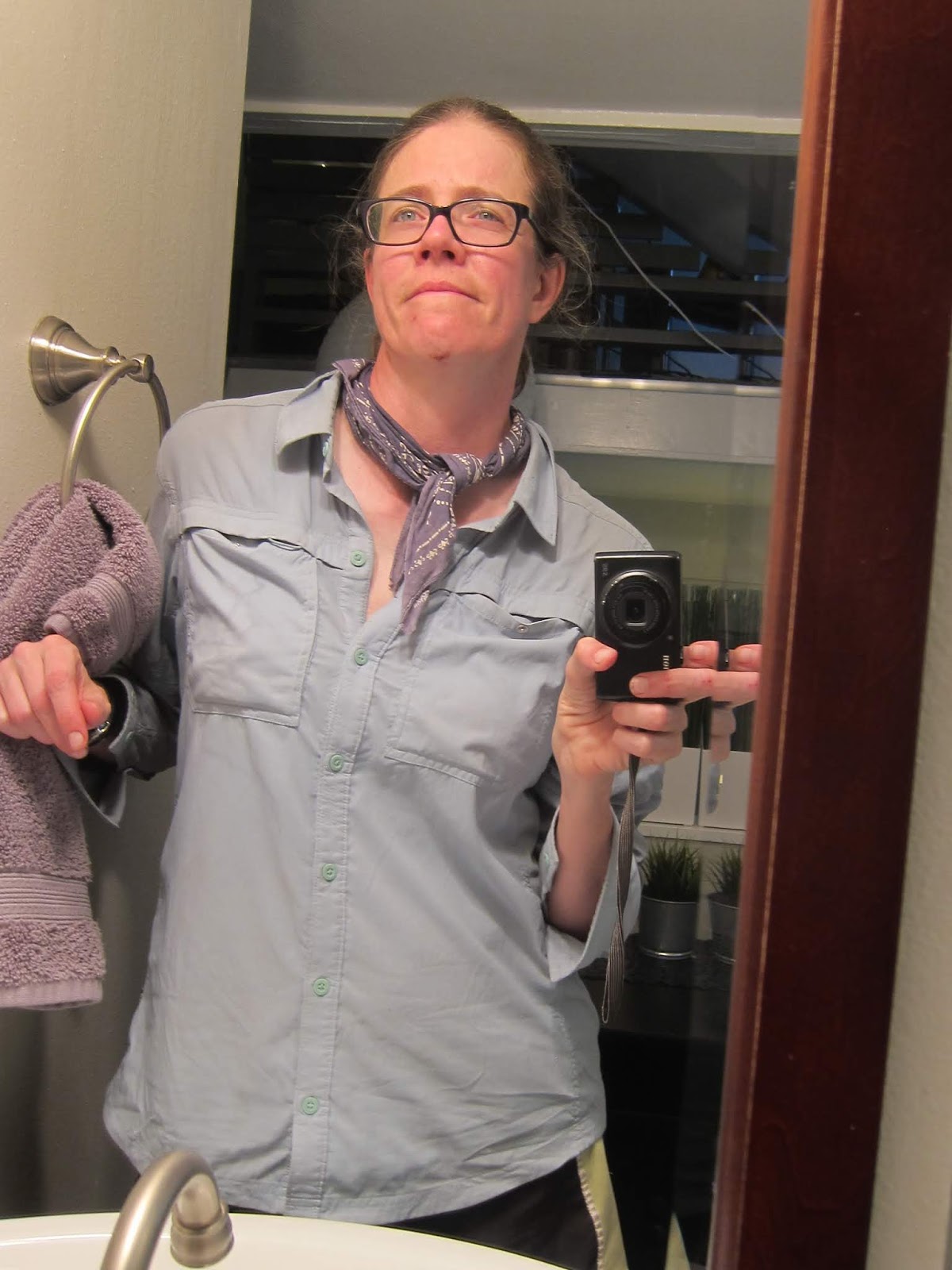
60. Mid layer: REI Sahara shirt. I wear this OR #11 dependent on temps. This one is for warmer weather.
I like this shirt, the buttons allow it to be worn in more ways than a pullover and it's a little bit cooler in the heat. Typically I'll wear this in the summer and the other shirt in the winter and shoulder seasons.
Not shown, because why would I show you my underwear:
61. Underwear: cotton briefs
There are many quick-drying synthetic underwear options out there now, but I haven't found them to be as comfortable -- and when you're walking a lot of miles in a day, you really don't want to be uncomfortable down there.
62. Bra: regular bra
I don't like sports bras.
That's it for clothes. The idea with backpacking clothing is that everything you bring should be able to be worn at the same time, in layers. There shouldn't be duplicates. The exception to this rule is if having a duplicate brings you exceptional joy -- for instance, if it really improves your mood to be able to change into a non-smelly shirt halfway through.
FIRST AID KIT
63. Antibacterial: small antibacterial packets
You can buy packages of these small single-serve antibacterial gels on eBay or wherever.
64. Blister patches: ENGO blister patches
These are a unique form of blister control in that they attach to your shoe, not your foot. They have an adhesive on one side and are slippery on the other, allowing your sock to move against your shoe without resistance. They're larger than this; this is what's left after I most recently cut some off for use.
When cutting pieces of something you're going to stick to something else, round the corners off or they will tend to get pulled up.
65. Bandaids: large bandaids
I mostly use bandaids for a quick fix on areas where my foot is getting rubbed, but obviously they're also good for cuts.
66. Tape: Leukotape strips
This is an item I would definitely not want to be without. It is the only thing I have found that will stick to my feet long-term. Leukotape is a fabric tape with a slight give to it, making it easier to wrap around curved areas. It will stay on my feet for a couple days of hiking before needing to be replaced. When I know that a particular shoe causes problems for a particular part of my foot, I will wrap that area before even starting the hike, to prevent blisters.
Leukotape comes in a long roll where the tape is stuck to itself, no backing. You can cut off shorter pieces for a trip and stick them to a backing that came with some other kind of adhesive item (such as nametags or mailing labels).
67. Bandage: self-sticking stretchy bandage roll
For holding gauze on in the case of a major cut
68. Gloves: nitrile gloves
In case I need to help someone else who has been injured
69. Sewing kit
I definitely recommend having a sewing kit for clothing and gear repairs on the trail.
70. Bandaids: medium bandaids
It's helpful to have different sizes.
71. Blister pads: 2nd Skin blister pads
I have yet to try these so I'm not sure how well they work. Supposedly good for if a blister has already developed. I would also like to pick up some 2nd Skin burn pads. I once read that burns are the #1 backpacking injury. I'm not sure I believe this and am curious to know what their criteria for "injury" was (though I have certainly given myself a few small burns by trying to handle my stove before it had completely cooled off), but in any case it seems like a good idea to have something on hand.
72. Foam: callus cushions
To provide a buffer around small injuries, blisters, or spots that are rubbing
73. Antiseptic: iodine prep pads
Supposedly better for your wound than alcohol pads
74. Gaze: gauze pads
In case of large cuts. I think I've only had to use my gauze once ever and it was on a day hike.
You'll notice a theme with these items. 95% of the time I dig into my first aid kit, I'm reaching for something to keep an incipient blister from forming.
My kit is missing a couple items present in most first aid kits. One is moleskin, because I haven't found any that will stay stuck to me. The other is medicines, which I keep in my sundries bag instead.
SUNDRIES BAG
75. Paper: scrap paper for writing
In case I want to write a few thoughts or leave a note.
76. Pen: it's a pen!
A space pen might be more appropriate, but this one is easier to hold when my hands are cold.
77. Reading material: article ripped out of a magazine
This is what I typically bring for reading material. Usually the time between stopping for the night and going to bed is filled with chores, and once I start reading in bed I immediately start to fall asleep, so it would be pointless to bring more than that.
78. Bags: more ziplocs, because bags are oh so handy
These can be used as extra trash containers or to keep a camera dry, or hold on to neat fossils, rocks or other items you find on the trail, or parts that fall off of your equipment (!).
79. Bags: bread bags.
Can go over dry socks and back into boots to keep dry socks dry, or over hands to keep gloves dry. Wash them first (but only after eating the bread).
80. Patches: patches for sleeping pad repair
These are patches specifically for the NeoAir XLite sleeping pad. Not sure if they will be any better than regular gear repair tape. So far I've never had to repair a pad in the field.
81. Lighter: Bic lighter
For lighting my stove. I chose orange to make it harder to lose.
82. Knife: Victorinox Swiss Army Nail Clip knife with nail clipper, scissors, tweezers, toothpick, nail file/cleaner, and small blade
I love this knife. You don't need a large blade for backpacking; it's unnecessary weight, as 99% of what you will be using the knife for is just cutting cheese and summer sausage (and you can use your teeth if it comes down to it!). I can't even remember the last time I used the blade on my knife. Scissors are more useful, specifically for cutting tape, pads, patches and thread. The nail clippers and file are also very handy for trimming problem toenails that may cause you pain. Tweezers are another item I wouldn't want to be without.
83. Tape: medical tape
Nice for holding bandaids more securely onto fingers, and other odd tasks
84. Medicine: small container for earplugs which carries not earplugs but my medication and NSAIDs
I will bring just enough of my personal medications and NSAIDs (I prefer naproxen to ibuprofen) for the length of the trip. May also include Benadryl for sleep aid/allergic reactions.
85. Candle: birthday candle for help getting a fire started in emergency
Just some extra assistance in case I need to start an emergency fire. I almost never make fires for fun while backpacking, both due to time/sleepiness issues, wet wood issues, and because I am often in sensitive areas that won't support a lot of wood gathering.
86. Hair tie: it's a hair tie. Useful for hair, or attaching things to things
There is nothing worse than having long hair and losing your hair tie. But hair ties are essentially a beefy rubber band, useful for other tasks such as attaching things to the pack, or allowing me to clip something via mini carabiner to a small tree limb.
87. Filter: coffee filters for use as pre-filter if water has high sediment content
I have yet to use these but the idea is that I would hold them at the opening to my hydration bladder when pouring in water via the filler ziploc, in cases where the water was either cloudy or had a lot of junk floating in it. So far I haven't come across this issue.
88. Paper clip: for who knows what
A useful just-in-case item that essentially weighs nothing.
89. Safety pins: you never know
Same
90. Game: 1.5" playing cards
I might bring these if I'm backpacking with another person. While they are tiny, I haven't found them difficult to play with at all.
91. Earplugs: Mack's slim fit soft foam earplugs
I use earplugs because there are a lot of noises in the forest, and each one sets off my alert system since I am already nervous about bears, and I tend to wake up. Earplugs allow a good night's sleep. Will I miss it if a bear actually does enter camp? Possibly. I did sleep through a mouse chewing into my tent and through my hydration bladder last summer. (Both of these things are very rare and may never happen to you!)
92. Back-up light: small LED light
This is a very tiny, near-weightless handheld light with a single LED. I bring this instead of extra headlamp batteries because there's always the chance of the headlamp itself breaking. It's bright enough to read and do chores by, and -- importantly -- allows you to set it in the "on" position without having to squeeze the button the entire time like most tiny LED lights.
93. Medicine: antacid and anti-diarrheal medications, with dosing instructions
I have definitely used the anti-diarrheal medicine and was very grateful for it. Make sure to have dosing instructions for medications you don't use frequently.
94. Pads: two panty liners, held with rubber band
These are multi-purpose items. They keep my mirror from being scratched, they're good if my period comes off-schedule, and they can be used for padding or liquid absorption if needed. I have a male friend who always puts a full-sized pad at the bottom of his trash bag to absorb liquid from food waste. Obviously the rubber band is a multi-use item as well.
95. Mirror: S.O.L. rescue flash mirror, small
For emergencies but also to allow me to examine facial injuries, see if something's in my eye, etc. See if my make-up is smudged (this is a joke).
96. Tape: Gear Aid Tenacious Tape gear repair tape
I use this instead of duct tape for gear repairs as it looks nicer, is easier to cut to shape, and can be cleaned off more easily if you want to remove it and do a "real" repair later. From my experience it works very well.
97. Compass: Brunton TruArc 3
This is just a light, reasonably priced compass that will work for navigation with a map. If you don't know how to use a compass with a map, you may as well get a mini compass instead just to see where north is.
The number of times I've used the extra features on such a compass (declination setting, ability to align with map) while hiking are backpacking has been very small. Three or four times perhaps? Normally you just want to see which way is generally north so you can tell if this segment that goes east-west on the map is the part of the trail you think you're on, that sort of thing. However, being able to properly use a map and compass is fun, and will allow you to identify distant peaks or find your way with certainty without having to rely on your (potentially dead or dying) phone.
98. Matches: UCO Gear compact safety matches
Back-up fire source.
99. Keys: house and car keys only
For weight savings, I remove the rest of the keys from my ring when I go.
100. Driver's license and credit card
Just in case. An emergency scenario in which I need to exit at a different trailhead and call for a shuttle (or grab a beer?) is not that implausible.
101. Umbrella: Six Moon Designs Silver Shadow
I only bring this for hot, low-tree-cover trips, attaching it via bungee to the strap of my pack. I don't really like it. It's very annoying when you have to go past trees, and when you've got it attached to the pack it's never going to be in the exact right position to block the majority of your body. When you hold it, your arms get tired. But it does cool you off 10-15 degrees and is obviously useful for blocking rain as well, or wind if you want to sit down for a break.
I actually use this umbrella more for summer walks at home than I do for hiking or backpacking. However, many people absolutely love their hiking umbrellas, and even use one and a wind jacket/pants in place of rain gear.
So, there you are. Apparently I bring around 100 items with me, depending how you count.