I'd planned to take a vacation in the mountains in August, but when it came time, the forecast said rain all week. So I looked for somewhere that wasn't going to be rainy and quickly settled on Dinosaur National Monument, where I'd worked the summer of 2011.
I was doubting my decision as I left Denver, because there were nothing but blue skies above me. And smoke.
A truck on fire just outside of town made for an inauspicious start. But I was soon validated in my decision, because by the time I reached the Continental Divide, thunder was booming.
Here, I took a little hike to stretch my legs. There were still fields of yellow wildflowers, though it was nearly the end of summer.
As I drove out onto the scrubby plains of western CO, storms pounded the land with intermittent rain.
Once at the park I found a nice campsite from which I could walk to a "beach" on the Green River.
It was oh-so-quiet that night--if you didn't count the nearly ear-splitting music of thousands of crickets--but I couldn't sleep. It was also quite hot, and would top 90 degrees the next few days.
With that in mind, I got up early the next morning for a pre-breakfast hike. It was quite nice at first, but by 8am the sun was beating down unpleasantly.
Making breakfast after my hike, I discovered that the ground squirrels at my site were truly brazen. It would become a problem throughout the week, as I couldn't turn my back on any food. If I so much as left my car open long enough to carry something to the picnic table, they would be in the car and eating through packages of food before I got back. Here, one tries to steal some oatmeal with me standing right there.
They also managed to find the bite valve on my hydration bladder. This is the second time I've had to replace a bite valve due to it being chewed on.
Ground squirrels weren't the only wildlife that was comfortable with humans. Here, a fawn wanders through, mewing like a kitten.
It was buggy at night, and sometimes difficult to enter the tent without letting them in. One morning, I opened my eyes to find two mayflies hanging above my nose. Then I realized it was just one mayfly, clinging beside its molt. This thing had felt comfy and safe enough to shed its entire skeleton, right above my face, while I slept. This was a first for me.
Another pest came out at noon: biting flies. I tried to work on my writing through all this, but eventually I gave up and went for a drive.
Along the river, I found where someone had laid out pebbles of all different colors. There are something like 23 different rock formations exposed in the Monument, an astounding amount. It makes a lovely place to look at rocks.
Within the boundaries of the park is a parcel of private land, a ranch. Irrigation devices sprayed water over bright green fields as the sun set.
I met another new friend in the bathroom that night. She'd be there all week. The bathrooms looked like no one had cleaned them since 1970, even after a staff member came by and cleaned them. If I didn't already love Dinosaur so much, it definitely would have put me off.
The next day, I continued with what would be my little routine: early morning hike, breakfast, then write in the shade at my site until ninety-degree noon and the biting flies hit. Then go for an air-conditioned drive, maybe with some brief side-hikes.
The central part of Dinosaur (an hour's drive from my campsite) is higher-elevation, cooler and breezier. It also has some great views.
Above is Mitten Park Fault. The actual fault is to the left of the layers that curve upward steeply.
For scale, see the whitewater rafts on the beach below:
Beyond the fault, the Green River winds through more canyons. Downstream a good ways, it will reach my campsite. Quite a bit further, it will join with the Colorado River in Canyonlands National Park.
Days when I returned to my campsite to find it warm and sunny, I could take a little dip in the Green River.
Or just sit with a book and a lukewarm seltzer.
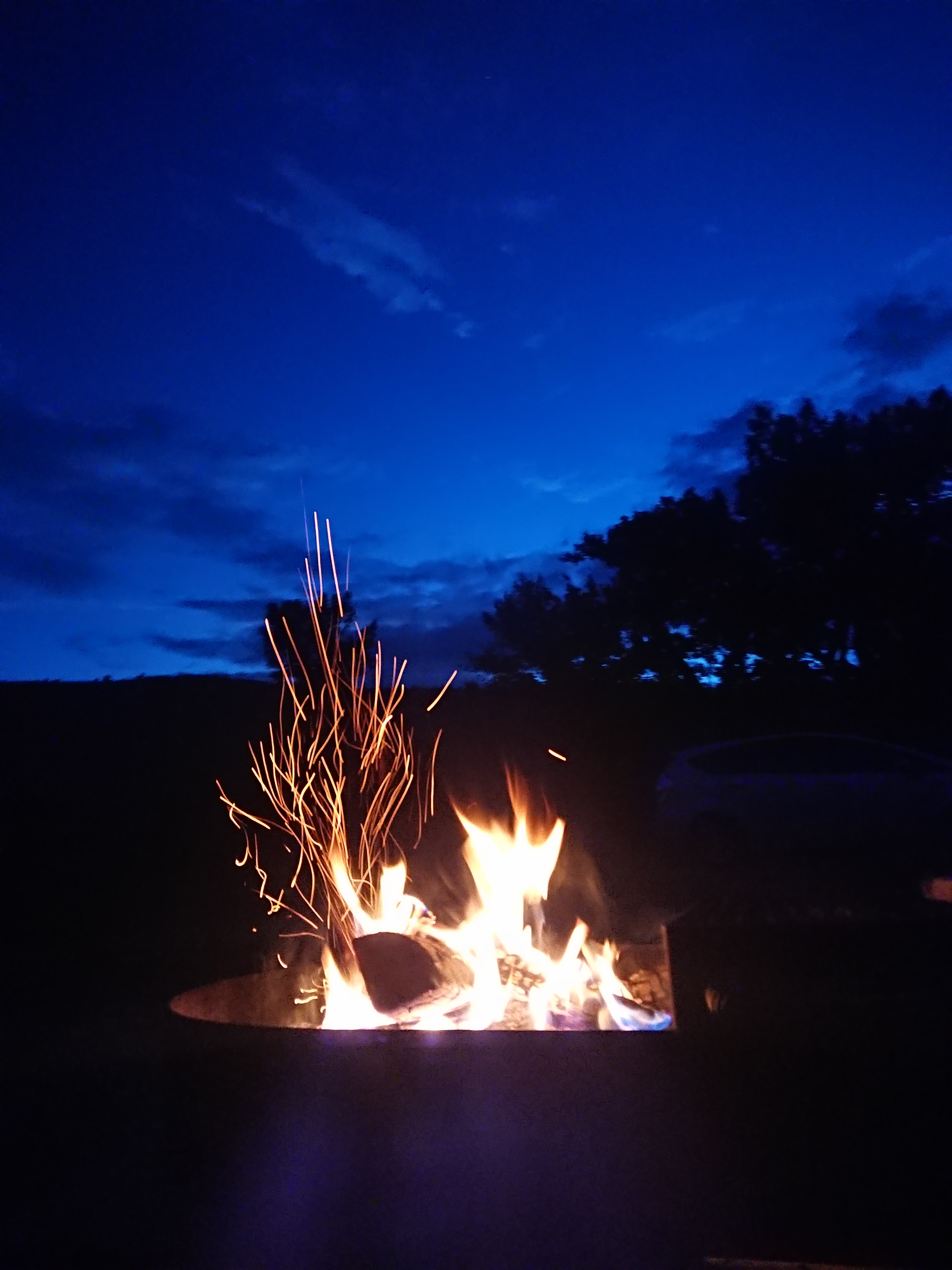
I'd bought some firewood and I had meant to have a campfire some night, of course, but each evening it was just too hot. So I gave in and made a campfire for breakfast one morning instead. After I got the fire going, I grabbed my package of foil and tugged on the loose end. A few inches pulled off the now-bare cardboard roll. Not nearly enough to make a packet of food to stick in the coals.
Instead, I balanced the narrow strip of foil on the burning logs and kept shuffling things to make sure it all cooked. But it was incredibly delicious.
A few times I had cause to go into the nearest town, Vernal, which is a wonderful place to visit if you're a fiberglass dinosaur.
Here, I enjoyed working in the cool, air-conditioned library, and eating too much restaurant food.
At a barbecue place, I waffled on whether I wanted a giant rice krispie treat, and ended up declining. It was just too big. But I think my waffling confused the woman at the register, because she ended up including a krispie treat in my bag, but not on my bill. It took me several days to eat.
Did I mention the days were hot?
But the park was always pretty in the evening light.
The heat didn't let up when the sun set. But that made it easy to lie out on the picnic table at night and look at the stars.
Some more photos from hikes around the park. Look at those formations!
Other parts of the park are covered up, in this case with sagebrush.
Horned lizard:
Tiny baby horned lizard:
BLM rangeland surrounds the park, with its attendant non-wildlife.
This cow was followed around the next bend by a cowboy and cowgirl on horseback.
A distant view of the Green River:
One evening, I walked from one campground in the park to another along a trail, then got to talking with a ranger there. By the time I walked back, there was just enough light to follow the trail. Rather than turning on my headlamp, I walked along in the gloaming, looking at the stars.
Until I heard a rattle.
I stopped where I was and turned on the headlamp. Can you spot the rattlesnake? At that moment I was glad that rattlesnakes had rattles, for hikers who temporarily forget how snakes like to warm themselves on rocks even after the sun goes down.
As the week wore on I made friends in the campground, and even got invited for pancakes. But then the week ended.
On my last night, I burnt the rest of my wood, though it was really too hot for a fire.
The next morning I packed up and went for one last drive to snag a final few photos.
Here is the Morrison Formation, in which dinosaurs are found, and which always reminds me of melting Neapolitan ice cream:
A family of wild turkeys crosses the road:
Monarch:
Petroglyphs:
A pleasantly cool box canyon:
The homestead of pioneer Josie Morris, who lived alone and used the box canyon as a corral for livestock:
A damselfly:
An unmaintained trail that now goes nowhere:
On the long drive home, I stopped once again at the continental divide to stretch my legs.
The blooms were still blooming, but it was stormy and cold. On my walk I met a couple from Denver who were familiar with Dinosaur, and we reminsced about the park. It's always interesting to make random connections.
The temperature continued to fall as I drove east, until by the time I got home, I was schlepping my bags in a miserable, chilling rain. The next day, I saw it had snowed in the mountains.
This seemed too much. It was, after all, still August. I didn't need any reminders that winter would soon be here.
But we never have a choice about the seasons, do we?