Painted Desert

Painted Desert
Showing posts with label PEFO. Show all posts

Thursday, July 17, 2008

Creature feature

There are many creatures here in the park. A list of the particularly deserty ones that I have seen:

Common lesser earless lizard
Common side-blotched lizard
Plateau lizard
Greater short-horned lizard
Plateau striped whiptail
Eastern collared lizard
Gophersnake
Roadrunner
Pronghorn
Mule deer
Desert cottontail
Jackrabbit
Coyote
Prairie dog
Antelope ground squirrel
Raven
Locust
Solfugid
Dung beetle

No rattlesnakes or scorpions so far. Some pictures of the creatures…

Plateau lizard:


We got one of these in the apartment once. It couldn't run on the linoleum very well. It looked like it was swimming in place. Here is a movie of Katie trying to catch it:

Greater short-horned lizard (AKA horny toad):


Jackrabbit:


Antelope ground squirrels:


Solfugid:


For those of you screaming horrified questions at your computer screen right now, a solfugid is an arthropod that is not a scorpion or a spider, though it has some things in common with those. They are also known as solpugids, and are sometimes called "wind scorpions" or, in barely-true emails that have been forwarded all over the web, "camel spiders," though they don't get as big here as they do in Iraq. They are fast runners and they run after their prey and catch it. We get one running in under the screen doors every other night here in the apartment.

This brings us to the most notable desert dweller out here, which is the humble ant. There are ants EVERYWHERE here. Billions of them. Small black ants, small brown ants, big black ants, big red ants, et cetera. I don't know what on earth they eat. This is sort of a spare ecosystem, there is not a lot of biomass compared to a forest. But I probably step on a hundred of them on my 5 minute walk from the apartment to the office each morning. And when I step on them their buddies come surround their corpses. Maybe that's what they eat. They have trails everywhere around the complex here. If you look close you can see the ants in this trail, which has been active for a couple months:


Here is an industrious ant carrying away a piece of potato chip from my lunch:


And it was probably ants that cleaned up this piece of creature that we found today:


It may be a bobcat skull, we took it back to the lab for comparative anatomy purposes, so we can study the bones.
Still haven't decided where we'll go this weekend... maybe Utah!

Wednesday, July 02, 2008

A typical day

6:00 Alarm goes off. Hit the snooze button.
6:30 Get up. Get dressed.

My field outfit:

Broad-brimmed hat, sunglasses (which I only wear if we are in an area with lots of white rocks, which reflect the light terribly), white button-down cotton shirt (much cooler than a knit shirt, plus it has a collar I can turn up), rip-stop nylon hiking pants, hiking boots. What goes in my pockets:


Knife (can scratch calcite, but will be scratched by quartz), compass, cloth to wipe glasses, chap stick, hand lens on lanyard.

Make lunch (always peanut butter & jelly, potato chips, and a piece of fruit). Have breakfast (almost always cereal).

The kitchen (note: photo not actually taken at breakfast):

7:00 Go to lab. Work on gluing fossils together.
8:00 Check in with supervisor to see if he needs me for the day. If not, head back to apartment and get ready to go out with Katie. Some of the gear that comes with me:


Rain jacket, nalgene bottle and hydration bladder with 2 liters of ice water, a bandana, lunch, sunscreen, ziplock bags for putting rock samples in, a pen, pencil and marker, a notebook for writing non-research-related thoughts in, reading material, a first aid kit, a small duffel bag for carring around equipment and samples in the field, a rock hammer, an awl and paintbrush for excavating fossils, extra pencil leads, eye moisturizing drops, extra bootlaces, and my field notebook.

8:30 Head out to work with Katie. Drive six miles through the park, open a locked gate, drive a ways on a dirt road then hike in to the site.
9:15 Start working. Hold the other end of the tape measure for Katie, or dig trenches while Katie relaxes.

10:00 It starts to get really hot. No breeze. A little bit humid since it's monsoon season. Everything begins to get hot. It's hard to even sit down since the rocks burn me through my pants. I have to be careful picking up my rock hammer or anything else metal. I don't find it draining… I can still climb hillsides and swing the big rock pick to dig trenches… but it is very uncomfortable. Sometimes we bring an extra cooler of ice water.


11:00 Snack. Back to work.
12:00 (sharp) Lunch. Find shade if shade is available, perhaps beneath an undercut sandstone ledge. Today we wedged ourselves into a small patch of shade; my feet were up by Katie's head, and her back was hunched so her head fit into the little cave. Eat sandwich, chips, fruit. Drink water.
12:30 Back to work, perhaps a bit refreshed though it's still very hot. Clouds have begun gathering on the horizon in all directions, but the sky above is still crystal blue.
1:30 Clouds finally begin to form overhead, and we have a chance of getting some shade. A breeze starts.
2:00 The monsoon storms begin to form, and we can watch them moving over the badlands.

The storms are patchy, but today one of them traveled directly over us. It began with a few drops, but within a couple minutes it was pouring—big, cold drops that quickly had us soaked.
We even had a little bit of hail. The worst was over after 15 minutes. I found it very refreshing, but it was cold enough that Katie got quite chilly and didn't really recover until the sun came out later. We had mostly cloudy skies for the rest of the work day.

4:00 Pack up and hike out.
4:30 Snack time again. A cold drink and some cookies or baby carrots.
5:00 I go back to work in the lab to clean and glue some more fossils. This "outside of work hours" arrangement allows me to get in my quota of lab work and have another full day per week in the field.
6:00 Come home, get changed and help make dinner. If we're grilling, we head out with a sports item like a frisbee to toss around while the meat cooks. It often becomes sunny again in the evenings, which is nice.


Last night, my birthday dinner was grilled steaks. These amazing steaks were $0.99 a pound at the local Safeway. We bought a seven-pound package and marinated them in what we had lying around, which included pickle juice and jalapeno juice. They were very good.

The woman on the right is our new roommate, who hails from England. We all get along very well.

8:00 Catch up on projects like reading, sketching or writing blog entries.
9:00 Play Diablo II with Katie. I brought this classic computer game in case I had lots of empty time (in reality, I'm busy almost every hour of the day) and got Katie sucked into the wonderful computer-game world of killing things and taking their stuff. So most nights we play for an hour and get a little bit further in the game. We are about halfway through it now (and halfway through my internship)!

10:00 Bedtime. It is usually cool enough in my room to sleep… we haven't used the air conditioning yet, the brick buildings are well-insulated… but I can always open a window. I can hear I-40 in the distance. I try to get 8 hours of sleep for the next gruelling day.

For the weekend of the 4th, we are planning to see fireworks in Flagstaff and maybe some of northwestern AZ's geological wonders. I will be sure to let everyone know how it goes!

Thursday, June 26, 2008

Exploration

First, the answer to the previous post's puzzler:
This is the piece of bone. Bone looks different depending where you are, but the pieces here often have a blue cast to them, and they definitely break differently than petrified wood or sandstone do. The best way to tell bone is to examine it closely and see if any of it looks spongy, as the inner part will. At least, that works with animals that don't have hollow bones. Also—I am not kidding—you can try licking it. Fossil bone will often stick slightly to your tongue. Try it by licking your computer monitor.
Last week we went out to try to locate a site excavated in the 40s by the late great paleontologist Edwin Colbert. He'd gotten a phytosaur skull there, and knowing exactly where it was would help us figure out the biostratigraphy of the area, or which life forms were present during which rock (and thus time) intervals. We had old color photos and a dot on a map. Unfortunately, nothing anywhere near the dot on the map looked anything like the rocks in the photos. Some scientists make careful notes about their location and activities in the field, but apparently Colbert was not one of them.
On the way home we drove around looking for rocks that looked anything like those in the picture. We passed a family of tourists who were jumping out of their minivan, their own old color photograph held out in front, everyone excitedly pointing into the distance. They were having more luck than we were.
The next day we went out to look for the lowest (and thus oldest) Late Triassic strata in the area. There was rumored to be some out west by the train tracks, so we went out a little adventure into unexplored territory.
We walked in a wash, or dry riverbed, until we came to some of the strangest rocks I've ever seen:
The rocks were white with splotches of blue, yellow and red, and they looked like a bad mosaic made by a five-year-old. It was sandstone cemented with calcite that had been colored by a rising and falling water table that no doubt changed the oxidation conditions of the iron in the sand.
After that we came to some brick-red sandstone that had split just so, making it look like bricks in more than color:
Later on I found a chert pebble with ancient Paleozoic fossils inside it (that's older than Triassic). These small fossils were probably some form of sea life, hundreds of millions of years ago when the ocean covered this part of the continent.
As we walked we came upon a game trail. There were deer and coyote prints in it. They'd all stayed right on this path, not stepping off it, unlike the cattle whose prints we could see all around.
A dust devil climbed the slope in front of us.
As we walked back in the river we could see fantastic forms in the river-bottom sediments. Here are layers of mud that were deposited by the river, then eroded:
Now, more on all these colors you can see in my pictures… two of the more important factors in controlling the color of the rocks are the reduction state of iron (whether the iron atoms have a +2 or a +3 charge) and the amount of organic matter. Rocks with high organic matter and reduced (+2) iron tend to be black, grey, blue, or green; rocks with low organic matter and oxidized (+3) iron tend to be yellow, orange, or red. And in this part of the geologic record at least, rocks with more sand (as opposed to mud or silt) tend to be whiter.
Here are some layers of red, white and blue. They record changing conditions or environments during the Triassic, from more to less sandy, and from wetter conditions or waterlogged environments (blue) to arid conditions or dry environments (red). In the blue layers can be found lots of fossils, especially of watergoing creatures like phytosaurs.
Here's a hillside with alternating bands of blue and white. This might have been a waterlogged area that experienced periodic influxes of sand. Maybe a swampy spot near a river, the edges of which were occasionally breached during floods. That's open to interpretations.
Here is a paleosol exposure—an exposed part of an ancient soil. It is red, so the iron in it is oxidized; it was exposed to lots of oxygen, meaning it probably formed in a dry area. But there are mottles in the paleosol. The white polka dots are areas of reduced iron that formed around those black dots, which are bits of organic material.
So I leave you with the pink polka-dotted paleosol.HH

Sunday, June 15, 2008

Phytosaurs and more

The phytosaur skull I found is slowly being worked on in the lab. Each day more of it is revealed from the rock by the fossil preparator. The skull still has some teeth in it, which is good… most of these skulls were rolling for a while along the bottom of a river until they came to rest, and the teeth usually snap off. Here is a picture of the skull now:
In case you can't tell, the end of the snout is toward the left, and the back of the head is toward the right. You can also see the ocular or eye-hole. I'm excessively proud of myself since it's one of the best-preserved skulls ever found here, and is the talk of the employees in the other departments, who have seen it and keep asking if I was part of the team that found it. I hear that someday it will go on display in the museum here. But it wasn't hard work to find it, I don't think.
I thought it was hard work digging it out though… my hands were all chewed up from contact with the rocks on the edge of the trench we dug around the skull… but the skull I found was in mudstone. Our supervisor found a skull the other day in sandstone, and it's been even tougher to remove. Here is our preparator using a rock saw to loosen some of the rock around the skull:
It's a big skull. You can totally see the outlines of it here:
The really crazy thing about this phytosaur is that parts of the skull are green. You can see an exposed section here:
We don't know why it's green. Perhaps it's radioactive. I happen to think "Radiactive Phytosaur" would be a great name for a band.
I mentioned that the second skull was harder to dig out because it was in sandstone. So what's up with sandstone and mudstone? They're two kinds of rock; the first is made out of sand that's been cemented, the second out of mud that's been cemented. (In between these two grades would be siltstone.) For a rock to be cemented, water has to trickle through carring some cement, such as silica. The spaces between grains of sand are bigger and so more water can come through with cement. Thus, sandstone tends to be a lot harder than mudstone.
In the beautiful badlands here, most of the hills are made of mudstone, which weathers softly. Occasionally there are bands of sandstone (marking where an ancient river channel was) and these can form cliffs.
The more pure mudstones here have what's called "popcorn weathering," a surface texture produced by the clay shrinking and swelling with the weather. It looks like this:
It forms nubbly hillsides everywhere. Here is Katie examining some mudstone; she's standing on sandstone.
When you dig a few inches into the mudstone, you get past the weathered surface, and can easily break off chunks of hardened clay that have very jagged edges and smooth sides. These are clods of ancient soils that formed on the floodplains of the Triassic. They have some fantastic colors. Here's a picture of a mottle in a clod of mudstone:
The black dot in the middle of the bullseye was probably a bit of organic matter than created "reducing" conditions in the surrounding soil; that is, it caused electrons to be donated to the iron in the soil. Iron happens to change color based on whether it's oxidized or reduced, and this causes a lot of the color changes in the beautiful badlands rocks. More on those colors later, as I promised.HHH

Thursday, June 05, 2008

Mapping and more

I've been going mapping with Katie lately. Mapping is important for understanding the paleoenvironment an animal came from, but it hasn't always been treated as important. Many paleontologists used to (and some probably still do) remove bones from the rock without making much note of what kind of rock it was and what its relationship was to the rocks around it. They might have a nice dinosaur skeleton but be unable to say whether it lived in a desert or by a lake. Nowadays, mapping out and describing rock units is key to understanding an animal's life history.
We head out to the field with topographic maps, a GPS unit, and colored pencils. We use the colored pencils to color the different rock units in on the map wherever we find them. Here is Katie studying the map as it relates to the surrounding terrain.
Mapping requires a lot of guesswork, especially where fluvial (stream or river) systems are concerned. Streams migrate over time, so a sand deposit formed in a streambed might be thin, it might change position as you move up into younger rocks, it might disappear entirely for a while. Some questions we might try to answer with mapping include: are the blue mudstones in the south area the same as those in the north area? Do they connect? Could they have been formed at the same time? Take a look at this picture. Is the sandstone I was standing on the same as the sand in that white layer in the distance? The only way to be sure is to walk it out. What if erosion has cut away too much to allow you to follow the sandstone all that way? You will just have to make your best guess.
While walking around we've encountered many interesting things on a smaller scale. Here's a picture of what are likely some fossilized burrows in the sandstone:
If you look closely you can see the horizontal layers in the rock. These are layers of sand and silt deposited by different stream conditions over time. After they were deposited, some animal made burrows in the streambed, and sand filled them in. The burrows stand out slightly from the rock because the sand is more resistant to weathering than the silty layers are.
I've also done some more prospecting and excavating. Here's a picture of some "arm" bones from a Triassic reptile…
Below see outlines of the bones (black) and the part I first spotted sticking out of the sand (white):
It has taken me a few days to learn to spot bone. Some day I'll post a test for you all: I'll take a picture of a flat with bits of all kinds of stuff on it, and you can see if you can find the bone.
I also found the end of what turned out to be the top half of a phytosaur skull sticking out of the flat, and this was excavated over the past couple days. Here it is during excavation.
We had to uncover enough to find out basically where the bone was, but other than that we tried to leave a layer of mudstone around it to protect the bone, which was a bit crumbly. Then we put the plaster jacket on:
We were able to flip the jacket upside-down without all the mudstone and bones falling out, despite it weighing an estimated 300 pounds. Later the preparator will carefully dig in and remove the bone fragments, gluing them together. When he's done the skull should look like the top portion of this one:
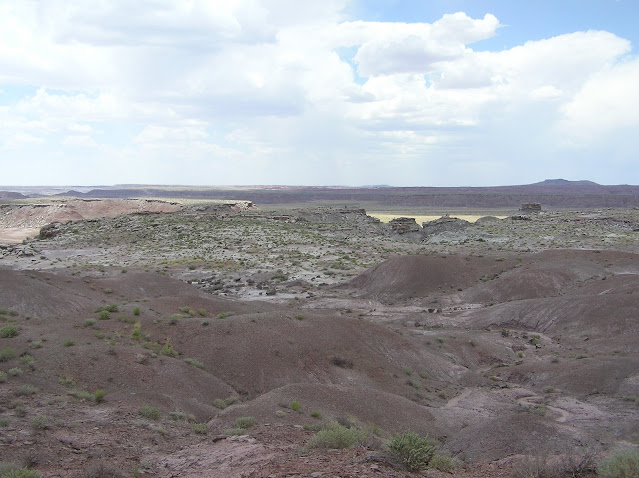
One of the nicest things about working out here is just the beautiful scenery. Here's where I spent the last couple of days:
Not bad!

Monday, June 02, 2008

The excavation

As we drove out to the site on Saturday, our supervisor told stories of excavations past. Four-hundred-pound plaster casts of bones being hauled for miles out of the wilderness, workers rotating around the skeleton so no one had to spend too long in the heaviest corner. Researchers using the last of their water not to drink, but to prepare more plaster to cover the final bones. The crew in Mongolia who ran out of burlap and began using their clothes to cover the last finds. It's good to know where the priorities are in this field.
The hope that we'd dig in and find a full skeleton beneath the previously discovered armor plates was balanced by the hope that we wouldn't find a full skeleton. Something that complete would take two weeks to excavate. It would be an exciting and significant find, but it'd also take a chunk out of the time we had to do the work that'd already been planned for the summer.
As we approached the site, our supervisor stopped in his tracks. He thought the area looked like a good place to find fossils. And it was in fact where we had found the fossils. I asked, "What makes this look like a good site to you?" and he said, "I don't know," which made me laugh. In the end, we didn't find much more than the scutes. The bright spot was that one of the scutes was nearly complete and in good condition for a Triassic-age bone.
We dug around the bones with awls and coated them with clear glue to lessen the chance of their breaking up. A moat was dug around the bones to put them on little pedestals of rock. Then it was time for the plaster. Toilet paper was placed over the bone and wetted to make it stay, and then plaster bandages were soaked in water and layered over the toilet paper and the rock surrounding the fossil. No plaster was allowed to touch the fossil. The pedestal was also wrapped, including a little lip that was dug slightly underneath. When the plaster hardened, the pedestal was chiseled under and the whole plaster cast flipped, leaving a nice package that the preparators could dig into and remove the bone in the lab.
This took most of the day. It was good work for an intern because there was plenty of opportunity for conversation as we dug around the bones, and that leaves time for me to think up questions to ask. I wasn't given a great deal of detail on what I'd be doing this summer before I got here, but I didn't expect I'd be working side-by-side with my supervisor, who has something like ten years' exerperience in the field. The other paleontologist on the team is a new PhD and it's good for me to listen to their conversations.
Some of you haven't had the chance to ask me the inevitable question, so the answer is, no, I don't want to be a paleontologist. No, dinosaurs aren't what I'm into. I don't dislike them. But I haven't found an area I'd really want to go into yet, so why not spend a summer doing something interesting? In gorgeous country, I might add. And why not learn everything I can about it? I may never do anything with paleontology again. But there's no reason to hang back all summer as if I may never do anything with paleontology again. So I intend to do as much and learn as much as I can.
We carried the plaster jackets back to the car and later dropped them off at the prep lab. That evening I went for a little walk in the wilderness area here, hoping to see some wildlife, but the only thing I saw was a funny beetle.
Yesterday Katie and I went to Flagstaff for some shopping and sight-seeing. Flagstaff has an attractive downtown with as much bike as car traffic, the peacefulness of which is shattered only by a screaming cacophony of train whistles every five minutes or so. Katie says that every train that goes at west goes through Flagstaff and this is not entirely unbelievable. Great long trains of double-stacked container cars pulled by three or four engines. I love to see trains and I like to imagine all the things being shipped on them that are not being shipped by trucks. But my god, the noise.
Katie was determined to find an authentic Mexican restaurant, but with luck against us we ended up settling on Thai. For some reason there are four Thai restaurants in the downtown area. I am thinking Flagstaff has a Thai population of some kind. We were asked how hot we'd like our meals to be, on a scale of 1 to 5, and I chose 3, thinking, you know, medium, like medium salsa, which is usually a hair too mild for me. But the 3 I received was more like the 4 or 5 of my imagination. The terrible part was that the food was exceedingly good. I didn't want to stop eating. But my tongue and lips were in searing pain. O delicious food of death!
We went to the Museum of Northern Arizona, which was small but very classy. I would recommend it to anyone passing through Flagstaff. And then we headed back home.
This week I am doing mapping with Katie and will also be exploring some of the newly acquired land here. On the weekend I will be going to Ghost Ranch in New Mexico, site of one of the most famous death assemblages of the Triassic, with hundreds of dinosaur skeletons. And to sign off, here is a pic from my evening hike the other night.

Saturday, May 31, 2008

First week on the job

Our first week on the job has been a mix of orientation, mapping and prospecting. We have been to several sites already. Many of the geo crew will be familiar with the site we visited in March; here's a pic I took of the fossils we found at that time:
Now flash forward to May:
I was a little surprised to see this still here, but why not? As we poked around on Tuesday, I got a private lesson in fossil hunting, including these handy tips:
Color probably won't help you. Objects such as petrified wood, bits of sandstone and chert, and carbonate nodules often share the same color as bone. Instead, look at the shape and texture of the pieces at your feet. It helps to have a knowledge of anatomy. Study the bones in the fossil prep lab in your spare time.
When you find something, don't remove it unless you're sure you can find the spot again. Don't make piles of bone pieces, as this could lead a future researcher on a wild goose chase, digging up the rock in search of the rest of the skeleton that seems to be weathering out. When it comes to deciding what to collect, consider the preservation quality, completeness and rarity of the specimen.
We found a few bits and pieces on Tuesday but the significant finds came Wednesday. I was set loose to prospect in an area that was being mapped, and wandered about a bit unsure of myself. I spent quite some time digging out bits of something I thought might be bone but which might also have been some concretions that formed around roots in the Triassic soils. I was not finding much of anything and for a couple hours was quite bored. But eventually the fact that I was outdoors in lovely and very quiet surroundings and able to explore whatever I wished became its own enjoyment and I started to find the job very relaxing.
And then after lunch, I did find something. It didn't require a tremendous amount of skill; in fact, I couldn't miss it. The previous day's advice about color suddenly seemed ironic.
These are the broken pieces of a scute (armor plate) of Typothorax, an aetosaur. The pieces are weathering out from under the sandstone body; tomorrow we'll go and dig and see how much there is. It's not likely that there's much more under there. Isolated aetosaur plates are much more common than complete skeletons. But one cool thing about this specimen is that the sand that was deposited on top of it by the ancient river formed a cast or impression of the scute, so the bottom of the sandstone looks like this:
I did a lot of walking that day and was amazed at how many different forms the desert could produce in just this one area. The colors of the rocks changed everywhere: purple, purple with white spots, red, white, striped red and white, green, orange. (I will talk later about what causes these colors.) And the bodies of sandstone weathered into different shapes everywhere. Out of all the hills and drainages I explored that afternoon, I found this particular pattern in just a couple square feet of it:
Here the sandstone has weathered into small spheres about the size of golf to tennis balls. Spheroidal weathering is common; any jagged edges on a newly broken rock have more surface area than the rest of the rock, and so receive the brunt of the exposure to the processes of chemical and physical weathering. Over time, rocks become round, even if all they're doing is sitting there. But, come on, how often do you see them looking like this without having been tumbled in a river? There were rounded boulders all over, but this was the only place I saw little rounded stones. Very odd.
That day I also found a spoon, blackened with age. Somebody's trash. I was about to bring it in when I realized it might be old enough to have turned from "trash" into "artifact." I was suddenly confused. Was I supposed to toss it in a dumpster or wrap it and mark its location in the GPS? In the end I just left it there, but after finding a couple parties interested in the spoon I believe we'll be GPSing and collecting it tomorrow after all.
The orientation I went through on Thursday wasn't quite as exciting, but I must say the facilities here are very nice. There's a community room with satellite TV, books and videos (I have not partaken of this yet), a workout room, a library, laundry room, barbecues, and a little post office.
The only other thing worth mentioning at this time was my being pistol-whipped by law enforcement. As we were dismissed from orientation I happened to lean back in my chair. One of our faithful servants of the law walked behind me and her pistol, hanging from her belt, clocked me in the head. She was very apologetic but of course I was more amused than anything else.
All is well and I am not having any troubles with the climate or anything else. Very tired. Looking forward to tomorrow. I will leave you with a picture from my evening ride the other night: