Painted Desert

Painted Desert
Showing posts with label Culebra. Show all posts

Thursday, June 12, 2014

Two and a half more days in Puerto Rico

Here is the continuation of my Puerto Rico pictures. To see the first part, including Old San Juan and the rainforest, go to Part 1.

When we arrived on Culebra, we found our guesthouse rental. It was a small studio near the airport, with microwave and mini fridge. There were roosters crowing in yards to either side of us. Everything felt sleepy. We paid and as soon as we had the place to ourselves, Sarah passed out on the bed with her mouth open for about an hour. This is the only picture I have of our room, but since I'm guessing she doesn't want me to show everyone how she looks sleeping with her mouth open, I edited her out:


After she woke we decided to walk to one of the beaches (Culebra is only about 3x7 miles in size). On the way, we saw a huge, magnificent rainbow. Then it began to pour. We sheltered under the awning of the school building and waited for what seemed like forever. The rain blew in sideways and soaked us. I was sure that soon it would pass and we would have clear, sparkling skies for the rest of our trip.


It remained cloudy and rained on and off as we continued toward Playa Melones, which is often accorded "best snorkeling beach." But by the time we got there it was getting too dark to go snorkeling, so we poked around a bit then headed into town for dinner. We ate at El Eden, where Sarah ordered the lobster risotto. It came in a bowl so huge that not only did she eat until full that night, but the leftovers sustained the both of us for two (2) further meals. That is five portions, basically. Between that, my food (which was a red snapper fried whole) and the good company we had, that meal now ranks as one of the favorite meals of my life.

As we had arrived at the restaurant it had started to pour again, and it was still pouring as we were finishing up. We had been speaking with two other couples seated next to us, and finally I asked if one of them had space for us in their car. (I had drunk one beer on an empty stomach and was still drunk... yes, I am a lightweight... which made me bold enough to mooch.) So we were able to avoid a 40-minute walk home in the rain -- or a long wait and $6 for a cab. And we proceeded to keep running into that couple for the rest of our trip.

The next day we were finally able to go snorkeling, which I have been basically waiting to do since the last time I went snorkeling, five years ago, also on Culebra. After having breakfast at the airport cafe, we began to walk toward the beach with our thumbs out, and the second vehicle that passed us stopped -- it was a publico, or public car, sort of a shared taxi. We paid $3 each to be taken to the main beach, and from there we hiked to Playa Tamarindo, which we had to ourselves for part of the day.

The water was as chilly as I remembered. I know I have read about people swimming in the warm waters of the Caribbean, but I have never experienced such a phenomenon. We were glad to have brought swim shirts. Even with the shirts, after being in the water for half an hour we were so chilly we had to swim constantly, not really stopping to look closely at anything, in order to keep from freezing.

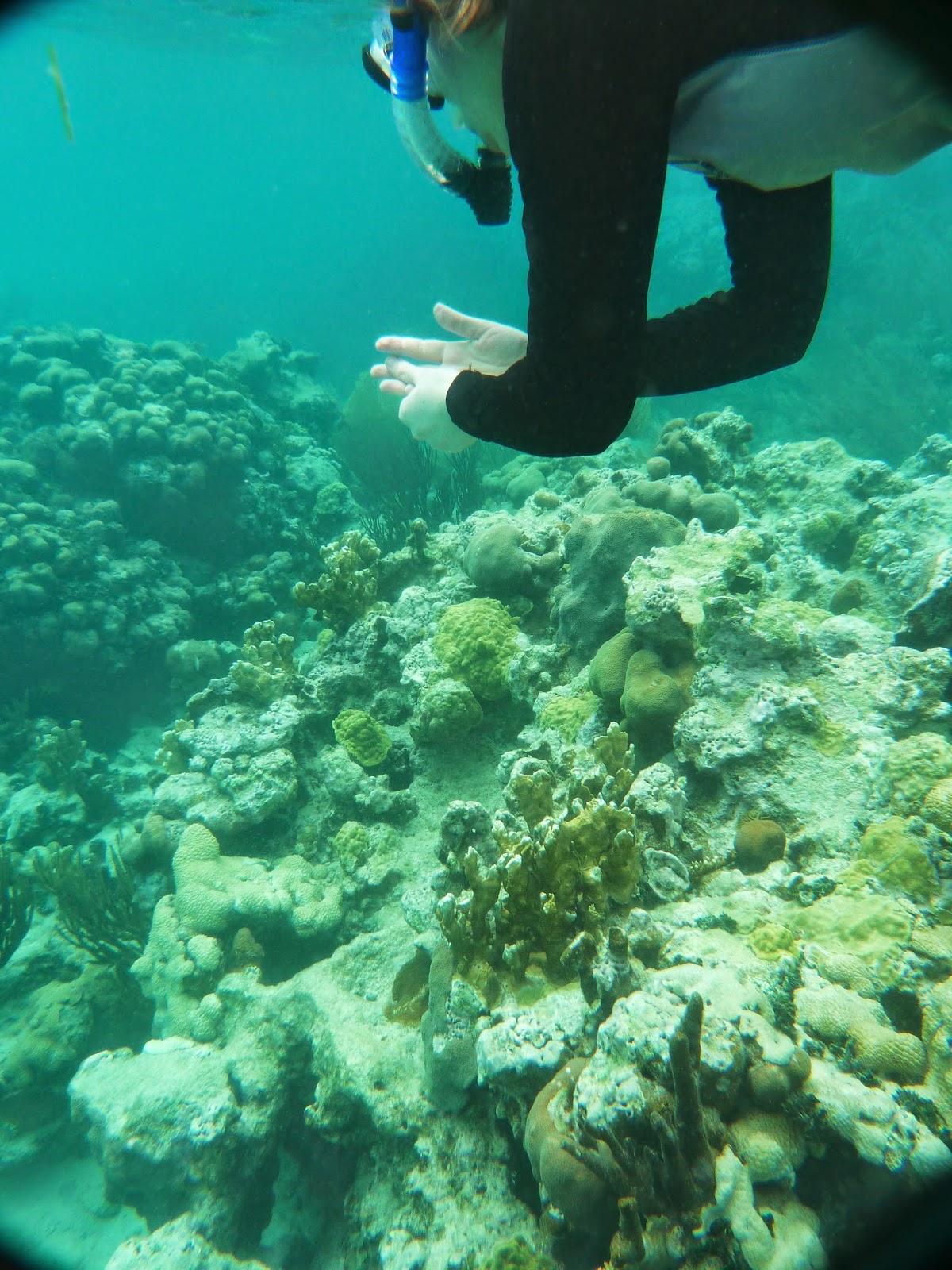
Because it had poured all night long, the water was cloudy with all the sediment that had washed into the sea. Our hosts told us it hadn't rained like that in months. And it was still raining -- sometimes we would come up to find raindrops pelting the surface of the water. But we saw a lot of fish and different corals. I happened to briefly spot a moray eel, which was a first for me, and we saw an eagle ray, though I didn't take a picture because the water in that area was just too cloudy. But here are some pictures from Tamarindo:


Bluehead wrasse


Yellowtail snapper


Sergeant majors


Sergeant major with brain coral


Sarah with coral


A shot of Playa Tamarindo taken from within the camera's underwater housing


Sergeant majors, a white-spotted filefish (at top, seen from above), sea urchin, pillar coral, and juvenile wrasses


A upper left, two spotfin butterflyfish


Damselfishes?


French grunt (on right) and trumpetfish (long slender brown fish hovering over coral on left)


After a couple trips in the water we were very cold. We hung out on the beach for a while trying to warm up, but eventually it started to rain again, so we put on some clothes and hiked back. It was kind of miserable.


There were food kiosks at the main beach and we ate one of the many kinds of meat-filled fried pastry ubiquitous in Latin America. I don't remember what kind it was. We had hot chocolate too, which helped. Finally the clouds lifted and we went for a stroll on the island's main beach, Playa Flamenco, which was nearly deserted at that time.


We came to the abandoned tank, left from when the U.S. used Culebra for bombing exercises. (I should say that a few days after we got home from our trip, some unexploded ordinance was found 10ft offshore, which is a fairly regular occurrence there.)


You can see how well my poncho protected me from the rain. Here is another tank that is located in the campground at the beach:


And then we walked all the way down the beach, and walked back to our rental. We had spent two hours walking that day and two hours swimming, which meant we were very tired, especially considering the four hours' walking and hiking of the day before. The sunset as seen from our street:
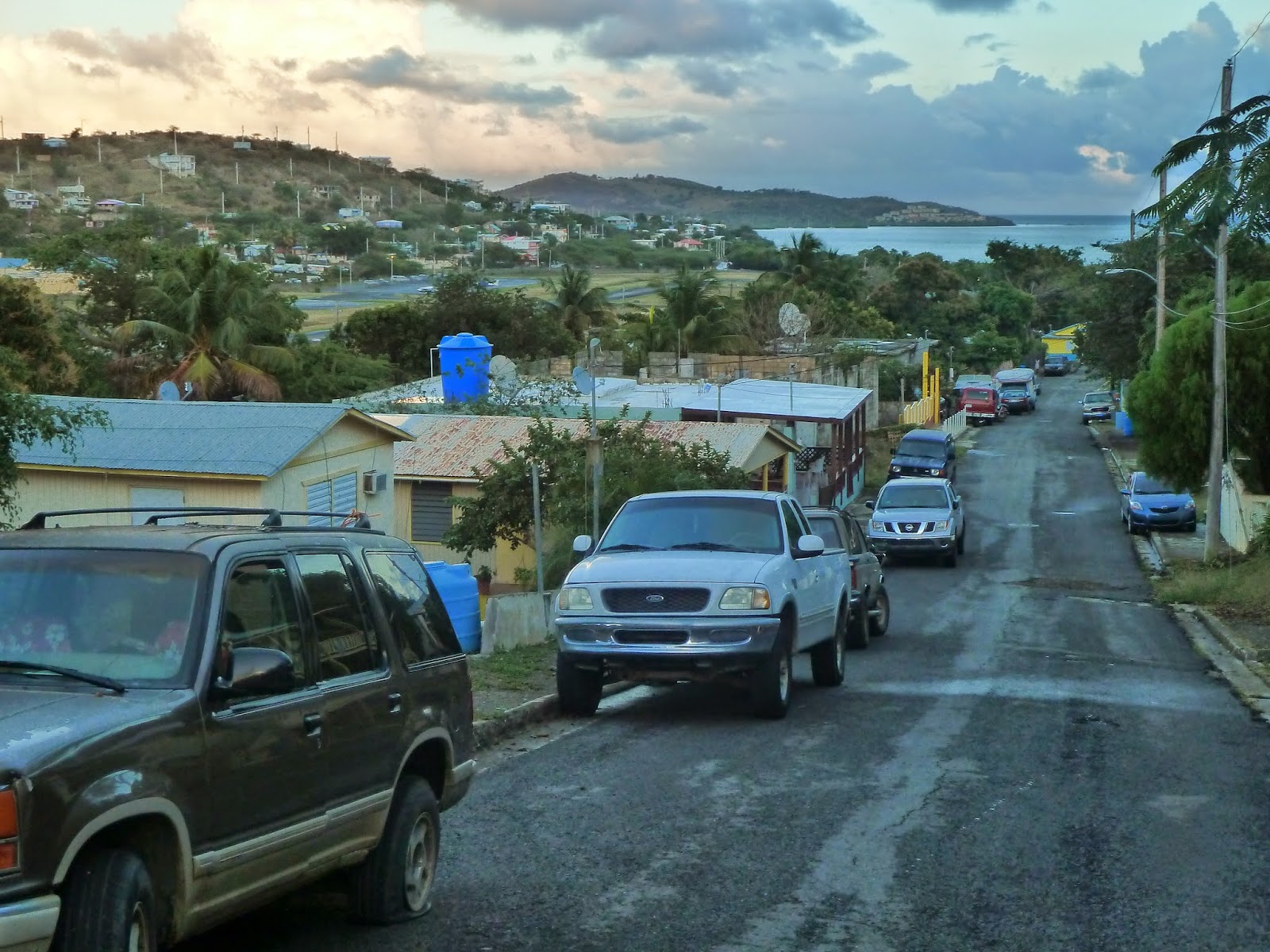


The next day, we were happy to be offered a ride from a Puerto Rican couple, who seemed to honestly want us to join them in the cab of their truck, but we said we would hop in the back and I'm glad we did because it was fun... I'm not sure I've ever ridden in the back of a truck before.


We again hiked away from the main beach to a little pocket of white sand and turquoise called Playa Carlos Rosario:


...where we again went in a couple times for snorkeling, until we became so cold I couldn't move my hands anymore. We saw some awesome things despite the cloudy water -- vast stretches of coral, giant brillantly-colored parrotfish, and a huge school of tangs. However, I didn't get very good pictures. After the previous day's pictures I'd noticed that my wide-angle camera made things look too small and far away, so I'd set the zoom in somewhat. But it turned out to be in too far, and as I couldn't see my LCD screen underwater and it was hard to tell where I was aiming, sometimes I aimed a little above or below the fish in question and the close-in zoom cropped it out of the frame. So I have lots of pictures of half a fish, or rocks. Lesson learned!




A peacock flounder, camouflaged on the rocks -- I might never have noticed it if it hadn't swum up under my nose.


The beautiful school of tangs, which we followed for several minutes as they fed (picture is not so beautiful)


Another non-lovely picture of the school of tangs


The front half of a stoplight parrotfish


Two beautiful stoplight parrotfish were hanging out together. Here are bits of both of them.


Another portion of some kind of parrotfish


After the snorkeling, we set up our hammocks and relaxed. For a little bit, anyway, until a party boat pulled up. They blared loud music while the partiers screamed at each other over the music for the next hour, until we gave up and hiked back. I took a final shot of the little beach. The water looked crazily turquoise then, though it doesn't really show in the picture.


Stay tuned for the pics from our final 2 days in Puerto Rico!

Friday, May 15, 2009

The swim shirt and the sea turtle

This is a continuation of the story of my trip to Culebra, which starts here.

On my way back from the exhausting Resaca Beach trip (see tourist map for refresher), I stopped at a kiosk near the airport. A group of Puerto Rican men were outside talking and one stepped inside to see what he could get for me. My choices were (a) pork kebabs, or (b) chicken kebabs. I ordered a chicken kebab and he pulled one off the grill and covered it in barbecue sauce, then took a slice of bread and stuck it to the end of the kebab. I learned later that this is standard procedure with kebabs but am unsure why... at any rate, it provides some evidence that Puerto Rican cuisine contains at least three food groups (I mean meat, starch, and barbecue sauce).

I began to walk back to the campground but when a publico pulled up beside me I was more than happy enough to pay the $3 to get back. I got changed and walked over the spine of the island to Tamarindo Grande Beach (also on the above map). This is about a 20 minute walk and is steep and rugged in some places, although people constantly made it in flip flops.

On the other side I discovered a narrow beach completely flanked with coral except for one opening wherein a swimmer might walk out to swimming depth beyond the coral. (See this picture for an idea of how the coral fringes the beaches... this isn't Tamarindo Grande, but it's vaguely similar.)

Remember the Culebra Forum, on which I'd read that even cold sleepers were warm on the island with just a flannel blanket? I had also read that cold people were also quite comfortable in the tropical water. So against my better insticts I refrained from purchasing a light wetsuit and instead outfitted myself with a simple lycra swim shirt.


I was cold. The water is cold! I don't care what these other, delusional people who have been swimming there think. It is very brisk. It is the sort of water you get into briefly to cool off when it's 90 degrees out, not the sort of water you want to hang around in staring at fish.

I stepped out through the gap in the coral reef. Here it was rocky, so there should have been coral, but something had made it impossible for the coral to grow, which was probably thousands of feet a year stepping on it. Once through the gap I could just barely stand. I put on my mask and looked around. The rocks near the gap were also covered in silt and sand and not very coral-fied, but there were a few juvenile fish the size of my pinky. It is very exciting for a first-time snorkeler to see these brightly-colored fish right next to shore and I think non-swimmers could be very content just poking around in these sorts of areas and watching them. But I knew there would be bigger fish ("better" fish) further off.

As I swam away from the gap, on the seaward side of the reef, the coral became larger and more colorful. There were many sea-fans, which were green and purple, swaying back and forth as the small waves came in and out. Even though these sea fans really characterized Tamarindo Grande I did not get a very good picture of them. Here is the sort of picture my Fuji underwater camera was able to take:

Here you can see a yellowish sea fan pointing straight up toward me in the lower left... there are some other soft and hard corals in the picture, and what looks like some quite small fish.

Here is some more coral and perhaps some sponges. I'm uncertain what I was taking a picture of here, but perhaps there's a fish in it. This coral does not look tremendously healthy, being mostly white, but some of the lack of color is due to the medium.

Underwater photography is difficult because the water does not allow long wavelengths (such as red) to travel very far. Blue, on the other hand, can travel great distances. If you're relying only on sunlight, red objects become black at no great depth, and everything takes on a bit of a blue tinge in just a few feet of water. Yet in real life, the coral I saw wasn't this drab; I believe the brain compensates much better for the extra blueness than the camera does, and when snorkeling we perceive things as closer to their "true" colors than we do with natural-light photography.

(This reminds me of a study I read about in which researchers placed a coke can at a depth of, I don't know, 40 feet, and told participants to scuba down and find the aluminum can and record what color it was. A great number--perhaps a majority--of participants said the can was red, even though physically no red light should be available at that depth and the can would appear black.)

Trying to take the blue out of my photographs has resulted in some clearly false color:

But the juvenile hawksbill turtle in the photo is not false. This was the only one I saw on this trip. It was maybe a foot and a half long. I wanted to watch its natural behavior but it swam away from me, and I didn't want to keep chasing it everywhere. In U.S. waters it is illegal to disturb marine mammals or sea turtles, and the rule of thumb is that if you approach an animal closely enough to make it change its behavior, that is disturbing it (though it is all right if the animal approaches you). Note the abundance of soft coral.

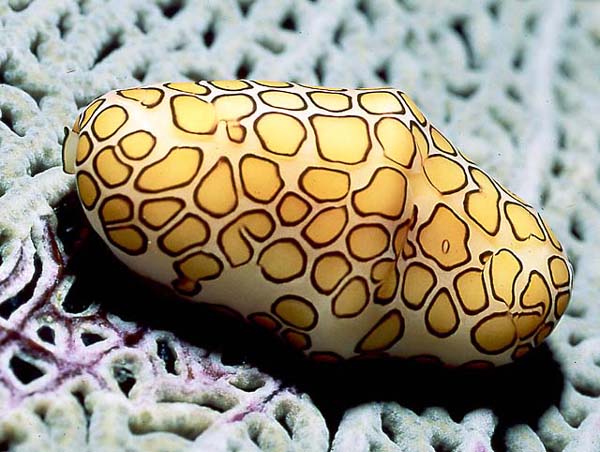
If you examine a sea fan closely you will often find flamingo tongue cowries on them. Cowries are a type of gastropod (like a snail), but are one of the few who extend their fleshy mantle over their shell, so when you look at a live one you are actually looking at its flesh, which is spectacular. Check out this lovely photo my camera never could have taken.

I managed to stay in the water about a half an hour, then returned the the beach to warm up a bit before clouds covered the sky and it became chilly out. I returned to my tent and ate a granola bar, carrots and chips for supper (not exactly gourmet, but it was a 45-minute walk to the nearest restaurant) and I was exhausted. I was falling asleep. I had only been awake for 12 hours.

At this time I was just beginning to appreciate the practical difficulties of my condition. I had somehow acquired a type of arthritis about a month previous, was still awaiting a diagnosis, and found my condition worsening while I waited. I could not keep my eyes open. It's true that I'd gotten quite a bit of exercise this day, but I felt like I'd been awake for 48 hours in some kind of Caribbean decathlon. I was asleep shortly after 8 PM.

Saturday, April 04, 2009

The cold and the cotton stainers

This is a continuation of the story of my trip to Culebra, which starts here.

The Culebra Forum at IslaCulebra.com is a peerless resource for anyone who'd like to visit Culebra. You can search the archives for your topic of choice, or post a new inquiry for residents and frequent visitors to answer. I'd spent a lot of time reading these forums, trying to decide what I needed to bring and what I didn't. There were many requests for information on Culebra's climate and I read through all the replies, how it was really very warm at night, how even cold sleepers had found a flannel sheet was more than enough.

I am a cold sleeper. I always doubt other people's advice on what to bring for sleeping. This time, though, I relaxed my guard a little. If other cold sleepers didn't need much, well. I just brought my fleece blanket.

I was cold.

I spent much of my first night tossing and turning, trying to get the blanket to cover both my wool-sock-shrouded feet and hood-cocooned head, trying to get warm. I was wearing all the layers I could manage and stayed above shivering temperature, but wasn't exactly comfortable. It could have been worse, though. The noodle bed was certainly supportive, if a bit firm.


Noodle bed, "pillow" made from clothing in duffel bag, black fleece blanket on top, hammock and some other items. Don't laugh.

It was cloudy so I decided to explore the island a bit. I thought it was important to find the nicest places early in my vacation so that I'd know where I wanted to spend my time. It wouldn't be any good if I spent the week at the beach I was camping on only to find on the last day that there was one I liked better down the coast, would it?

With my tourist map, the most accurate-looking representation of the land I'd been able to find, I set out to travel from Flamenco Beach, where I was camping, to Resaca Beach. I walked south up the steep road from the coast, looking for the jeep trail the map indicated led northeast to Resaca. After a bit of back and forth I still hadn't found it, so walked down toward the airport to try to find the real road that led toward the beach. I walked past a hill that reminded me just how dry the island is.


It took about half an hour to get to the airport. It was beginning to get hot. I started wandering around the nearby roads, trying to figure out whether I was on the right one. I found myself on another jeep trail that wandered behind the airport, came out onto a brief stretch of newly paved road in the middle of nowhere with benchless picnic tables under cupolas overgrown with grass that looked like they'd been built in a fit of optimism five years ago and then forgotten about, and which soon turned into a jeep trail again.


The sun came out. I walked past houses with TV blaring, houses with men working on cars out front, barky little dogs, lots of chickens, tourists in rented jeeps. I hit on what I thought was the right road and started climbing up to the spine of the island. It was steep as heck. I took a picture of a similarly steep road across the bay.


Walking up to the end of the street was like climbing six flights of stairs. I hadn't put on any sunscreen and even as the sun came out I nixed it for my legs, reasoning that I'd be vertical and there'd never be much direct light on them. I looped around jeep trails, trying to find my way up over the mountain.


Ensenada bay (perhaps the safest from hurricanes in all the Caribbean), with the town of Dewey. In the distance is the island of Vieques.

I passed an old trailer that was disintegrating in the elements, and was struck by the contrast between it and the newer buildings along the bay.


I realized I wasn't getting over the mountain, came down and found the actual right road, which went up and up and up. It turned from an asphalt, house-lined climb to a white concrete road winding through trees with only an occasional vacation house visible through the branches. I walked over a little bridge, peering down into the ravine on one side, and just caught sight of a big iguana before it dashed into the grass. The first time I'd seen one in the wild! And the road kept climbing. I'd been walking for three hours now, on a quest that was meant to take only about an hour. After all, Resaca Beach is just along the coast from Flamenco. Now I was sweating under the hot sun, far away from any beach.

I heard a noise and turned around.


It was the first horse I'd seen on Culebra. There are tons of horse on Vieques, of a special breed called the paso fino. This horse naturally has a very rapid, smooth gait with almost no bouncing up and down and they're sort of oddly fascinating to watch (see this amazing video on YouTube). I interacted with this horse for a bit, forgetting the ache in my shoulders, until I heard another noise behind me.


How cute! The foal was less interested in me than the mother was. I watched them for a bit longer.


Then it was back to the climb. Not long before noon I reached the top of the road. There was a sign for the Culebra National Wildlife Refuge, telling me I was approaching a sea turtle nesting beach. My tourist map said the beach was a half-hour hike down the side of the mountain. A half an hour? Surely not! It covered an itty-bitty distance on the map! I was happy to get into the full shade and began clambering down over basalt boulders through the forest. It wasn't long before I noticed there were lizards everywhere. Tiny brown and grey lizards. I got a picture of one that was little wider than the blade of grass it was resting on:

If your browser allows, click on the image for detail. I assume it is a Puerto Rican anole.

The trail passed down into a spooky mangrove forest, branches and roots everywhere.

These mounds, which I saw many of on the trees, were a mystery to me. This one was maybe a foot and a half high. Its surface looked like lichen.

At last, after exactly half an hour, I broke out onto the beach. The waves were absolutely pounding the coast in a strong wind, and sea spray made the whole scene look fuzzy, out of focus.

The wind was coming in from the northeast and the waves were breaking chaotically, in all directions, up to five feet high or so. I couldn't imagine anyone wanting to swim here. The sand was more orangey than the picture shows. I took a long walk up the beach in the roar and spray, seeing human footprints but no other signs of people. I did see these tracks:

Undoubtably from an iguana, with the tail drag mark. I also found this on the other side of the beach:


A sea turtle nest! You can see the tracks made by the sea turtle and a hollow where I presumed the eggs were buried. I was also able to do a little beachcombing here as there were a number of very small shells, including a real treasure... baby nautilus shells.

The nautilus is different from other mollusks. Take a look at this picture of a nautius shell sliced in half. Unlike a snail shell, which is all open on the inside, a nautlius shell has chambers that are closed off except for a small tube in the wall of each. A nautilus can control its bouyancy by inserting part of its body into the different chambers and pumping as many as it likes full of gas. Thus it cruises the ocean, catching food with its tentacles, much more like a squid than it is like a snail, though all are related. At any rate, nautilus shells are unmistakable. My little specimens, less than an inch in diameter, had the chambers and tubes just like the big ones you can find for sale as home decorating items.

Before I left I visited the far distant end of the beach, looking again for that elusive jeep trail the map said was supposed to exist, to find nothing but a mysterious cabana erected by some vanished visitor:


I slipped back into the forest and began my hike back to the road. I did see another kind of lizard, a Puerto Rican ameiva. These were much bigger, though they wouldn't let me get close.

Perhaps the oddest thing I saw, though, was this:

These bugs are called cotton stainers, because their bodies can get crushed into the cotton they feed on. I would guess they're mating, though possibly they're playing rugby.

Tune in later for the rest of my adventures!